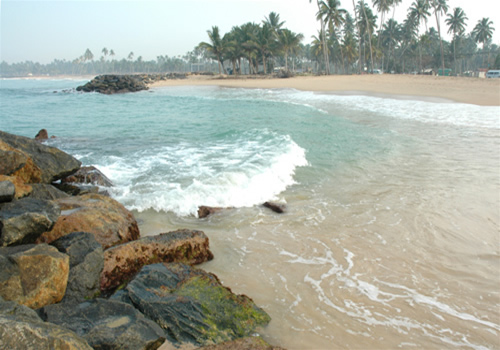
A gorgeous beach
South of
Bentota Bay Beach Resort, the road &
railway line run close to the long & continuous stretch of beautiful
coast to arrive at the town of
Ambalangoda,
86 km (54 miles) from Colombo. The town has a gorgeous beach. While the
beach resorts of
Bentota Bay Beach Resort,
Beruwala Bay Beach,
Unawatuna
Bay Beach &
Hikkaduwa Bay Beach provide energized activity & luxury,
Ambalangoda provide a feeling of seclusion & opportunity to explore its
long stretch of undeveloped beach.
The Amazing Masks
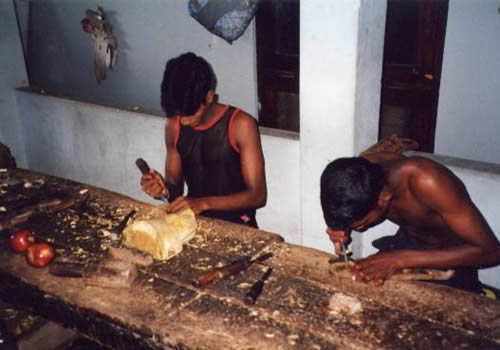
The town is famous for masks & puppets. The traditional masks are carved
from light Balsa like Kaduru wood (Nux vomica). Kaduru trees grow in the
marshy lands bordering paddy fields. The wood is smoke dried for a week
in preparation. The hand carved & hand painted masks in traditional
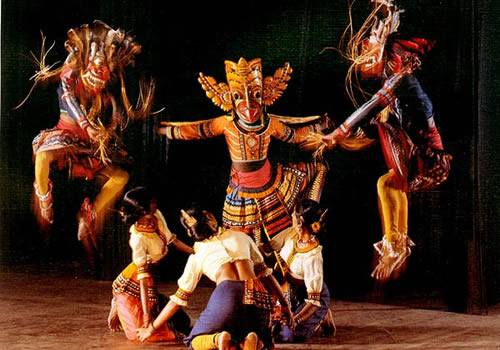
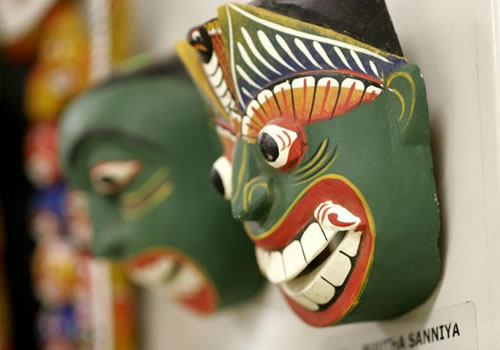
dance dramas are vibrant & colorful. The colourful & vibrant naga raksha
(Cobra demon) mask of the Raksha Kolama (Demon dance), consist of a
ferocious face with bulging, popping & staring eyes, a bloodthirsty
carnivorous tongue lolling out of wide mouth armoured & armed to the
hilt with set of fanglike teeth, & all topped by a set of cobra hoods.
The masks used in the exercise of so called demon dance exorcism are so
grotesque, the dance itself is utterly devilish to the breakneck pace of
the explosive drums, the whole exercise would halt the march of folly of
evil itself, the long strides of the devil himself. If so the, the aim
achieved (didn't we say, we aim to please), all would be in fine fettle,
every thing would be in ship shape, all chicks in fine fettle & all
would be happy & jolly. It cannot get any sweeter, isn't it?
Mask museums
We can view the traditional mask craftsmen busy in their trade at
workshops. On display at museums are masks symbolizing all the vivid
characters, demons, gods, heroes & villains who appear in traditional
mask dances. You will have an opportunity to delve into the mysteries,
legend, exorcism & psychology in the world of mask dances. Once
practiced in the hinterland villages in Sri Lanka, mask dances are now
performed mostly for the purposes of tourism & that too mainly in the
western beach resorts.
Traditional Mask Dancing shows
Traditional dancing shows take place about once a week at Bandu
Wijesooriya School of Dancing. A typical show begins with a kolam dance,
then follows several ritual dances, a village folk dance, & end up with
some short Indian dances.
Handicrafts
While the town is an important commercial & fish trading centre, it is
famous for its other handicrafts: hand woven cotton, finely carved
wooden doors, screens & lintels.
Galgoda Sailatalaramaya Maha Vihara Temple, Karandeniya
The temple is located 11km inland from Ambalangoda at the village of
Karandeniya. We can do it the easy way or the hard way. Of course, never
to take a back seat, we will do it the hard way, by way of 208 steps
instead of reaching the temple by the road. If the murals invite you for
closer view, the Buddha statue in a long unpretentious building sweeps
you off the feet. The reclining Buddha statue is 35m long, the longest
in the Buddhist world.
The astonishing view at the temple
The astonishing view up-country stretching to the faraway mountains
includes legendary
Adam's Peak. It is seen most clearly in the morning,
before 10am, & the area around is lush with cinnamon groves.
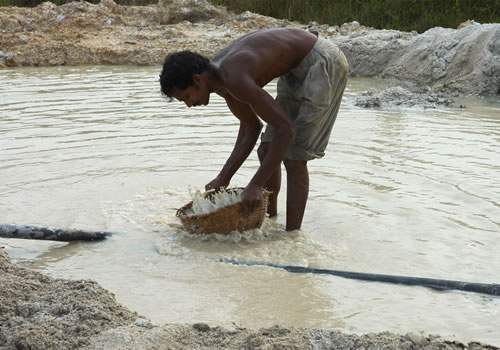
The village of Meetiyagoda near Ambalangoda is where the moonstone is
found concentrated within an acre of land believed to have been blessed
by the moon.
The mysterious gem, captivating as a full moon gleaming in the night
sky, is considered sacred & has appeared in jewelry for centuries. A
mesmerizing interplay of light, known as schiller or adularescence,
causes a silvery-white sheen to glide like veils of mist across the
milky surface of the moonstone. Some believe that this moving light is
evidence of a living spirit that dwells within the gem. Gemologists,
however attribute the shimmering phenomenon to the presence of albite
crystals embedded in feldspar.
The most sought-after moonstones have a haunting blue sheen, an effect
produced by the orthoclase feldspar, which is found almost exclusively
in the mines of Sri Lanka
Sunandaramaya Mahavihara
This is one of the earliest Buddhist temple on the south coast,
which might account for its thorana (gateway), the largest on the
island. On the outer wall of the shrine room are some rare murals
depicting Jataka stories (stories from the previous lives of Buddha)
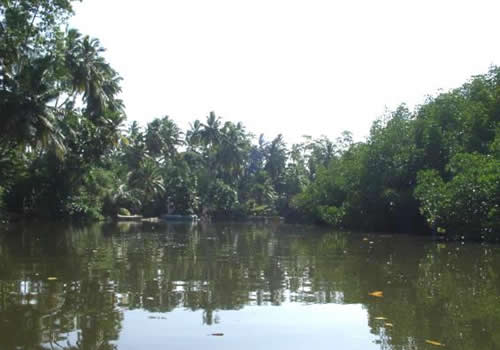
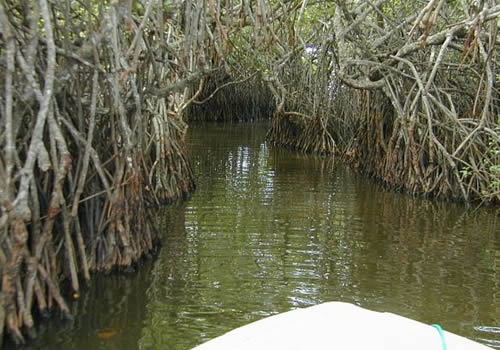
915-hectare Madu Ganga Estuary is connected by two narrow channels to
the Randombe Lake, forming a complex wetland system encompassing 64
mangrove islets. In the year 2000, International Union for the
Conservation of Nature (IUCN) undertook a detailed biodiversity survey
of the region & revealed the existence of no less than 10 major wetland
vegetation types supporting over 300 plant species & 248 species of
vertebrates. This remarkable diversity has led to its being classified
under RAMSAR Convention on Wetlands in 2003. The other two wetlands in
the island with the same international distinction are Bundala National
Park & Anawilundawa Sanctuary.
We can take a boat trip up the Madhu Ganga. Ganga means river in Sinhala.
Plans to develop a sustainable eco-tourism program
There are plans to develop a sustainable eco-tourism program within the
wetlands & educate villagers as it is already threatened by human
activities & large-scale fishing operations.
Kodawa Vihara
On one of the islands in the Madu Ganga is the 150 year old Kodawa
Vihara Buddhist temple which is home to five monks in meditation.
Nobody beats Ceylon Cinnamon
Cinnamon time
Sri Lanka is a major (80% of the world's output) high quality cinnamon
exporter. Ambalangoda is famous for its cinnamon cultivation &
production. We need to arrive at the cinnamon time, this being a prime
time show, to see the skilled cinnamon peelers harvest this prized bark
off the laurel just after the rainy season has soaked it to the skin,
making it easier to peel. Like Sri Lanka's ancient art of mining gems,
cinnamon-peeling too is a highly skilled technique almost unchanged over
the centuries.
A cinnamon bounty to Portuguese
In 1518, when the Portuguese returned to get their teeth into the
island, the annual tribute they extracted from the Sinhalese King
Bhuvenekabahu for protecting his grandson Dharmapala was a hefty 110,000
kg of cinnamon bark
Ceylon Cinnamon (Cinnamomum zeylanicum) - High quality Cinnamon
The affinity between Cinnamon & Sri Lanka (Ceylon during the British &
Zelon during the Dutch period) is such the botanical name of Cinnamon is
derived from the Island's name during the Dutch. Cinnamon was the holy
grail of European invaders of Ceylon. Sri Lanka produce high quality,
sweet delicate cinnamon: peeled cinnamon sticks & highly prized cinnamon
oil with its anti-fungal & anti bacterial properties. The largest
importer of Sri Lankan Cinnamon is Mexico, where it is drunk with coffee
& chocolate & brewed with tea. Giving flavour to curries, cappuccino,
all American Apple pie, Ceylon Cinnamon is one of the rare spices that
suits both palettes - Continental as well as Oriental.
Cinnamon in Madu Ganga (river) (Ramsar wetland)
In addition to fishing & traditional occupation of coconut coir, the
inhabitants of 65 little islands in River Madu are engaged in the
cinnamon production.