 |
 |


|

|
||||||||||||
Sri Lanka Holidays |
Home | Nature/Adventure | Ancient Glory | Rich Package | Sri Lanka Holidays | Total Holiday Experience | Travel Guide | Lanka History | Hotel Guide

|
||||||||||||||||||
|
Home | Nature/Adventure | Ancient Glory | Rich Package | Sri Lanka Holidays | Total Holiday Experience | Travel Guide | Lanka History | Hotel Guide |
|
|||||||||||||||||
|
 |
Tissamaharama, Sri Lanka
Tissamaharama is one of the most pleasant towns in the southern coast.
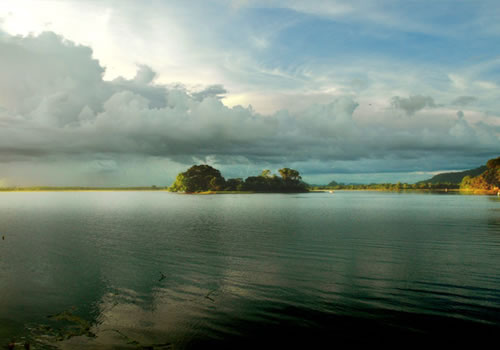
The beautiful man-made tank (reservoir) in Tissa, Tissa Wewa with
its remarkable bird life provides the scenic backdrop to the town. Tissa
was the sanctuary in the deep south, where Sinhalese patriots fled to
rally support against marauding Dravidian invaders from Southern India.
Known by the name of Mahagama (great town), it was one of the
principal settlements of the southern province of Ruhuna.
Mahagama was founded in the third century BC by a brother of the King
Devanam Piya Tissa of Anuradhapura,
& later rose to prominence under King Kavantissa, father of the hero of
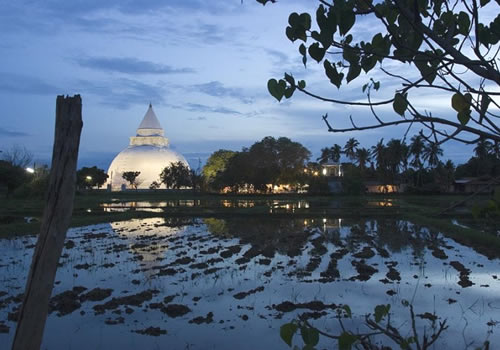
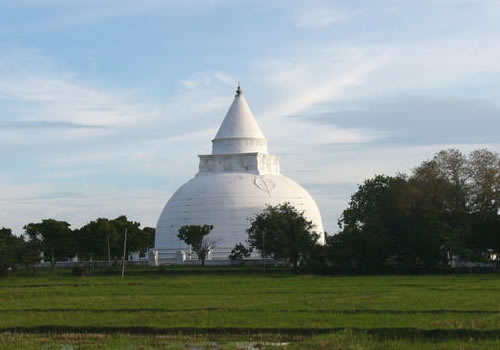
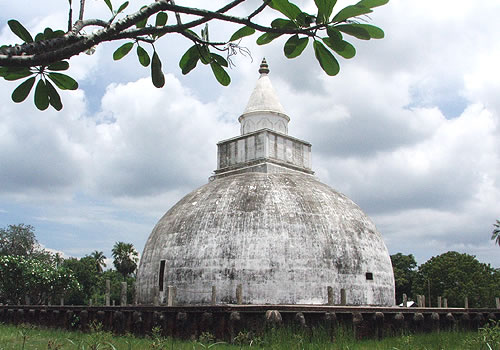
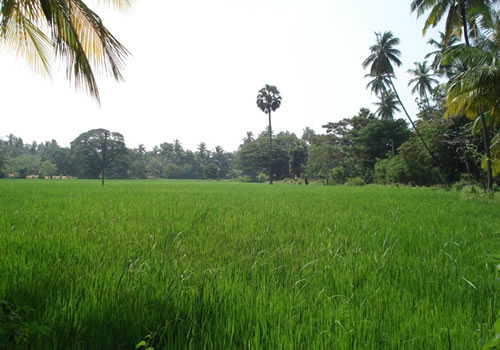
the nation, King Dutugamunu of Ruhuna. I walked along channel that leads through the paddy fields towards the great Dagoba. This is a holy and a beautiful place, where man and nature are peace with one another. The fish in the channel come swimming optimistically towards the pilgrim as he looks down into the clear water: two fat kabaraoyas (iguanas) [1] replete with insects, lay basking and blinking in the mud, and took no more notice of me, than to put out their forked tongues once or twice as I passed: in the bushes beside the stream a whole colony of weaver birds were busy chattering and arguing over family matters around their pendent houses. Kindness to man and beast had been practiced here for many long generations: the birds were without fear, and some reparation to the iguana family for the cruelties practiced upon it in other parts and other days in Ceylon. Sir James Emerson Tennent (1804-1869): Natural History, Year 1861, London It was somewhere about 220 B.C. that King Maha Naga, the brother of Devanampiyatissa, set men to work to build the Tissa Wewa at Tissamaharama. He constructed the bund, dammed up the Kirindi Oya and turned the water into the tank. For some mysterious reason the kingdom of Magama, or Tissamaharama, declined not long after Dutta Gamini [2] led his forces northwards to recapture Anuradhapura, and the tanks in the neighbourhood went back to the jungle. It was not until 1876 that the Tissa Wewa was restored and the jungle was beaten back. In 1890, 1500 acres were planted with rice below the bund of the Tissa Tank. Constance Frederica Gordon Cumming Two Happy Years in Ceylon, Year 1892, London ‘Ila Naga (first century A.D.) built the great dagoba at Tissamaharama, then known as the Naga Maha Vihara’ Humphrey William Codrington : History of Ceylon William Orr, who visited it in 1800, describes it as a village of twenty inhabitants, with a Rest house, and ‘field of paddy ground, containing thirty-five ammonams, [3] watered by the River Keerindeoya, when in cultivation, but having lain waste for these last seven years, in consequence of the desertion of the greater part of the inhabitants, whose motive for emigration is ascribed to fear of wild beasts, which infest this part of the country to an incredible degree and increase in number as that of the inhabitants diminishes.’ A description of Ceylon: James Cordiner, Year 1807, London In 1802 Governor North made a visit to Tissamaharama, and the report of his journey says that ‘Mahagama is a considerable village, containing a good number of inhabitants, who cultivate paddy, but they complain that for seven years past they have had no crops, owing to failure of the rains.’ A description of Ceylon: James Cordiner, Year 1807, London In 1834 Major Forbes narrates on Tissamaharama: ‘From Hambantota I turned inland on my way to the village of Wirawella, situated fifteen miles from Hambantota, and within two miles of the ruins of Ruhunu Magama; but, never calculating on any interruption in the immediate neighbourhood of so large and populous a village, I started before daylight. However, I had only just got clear of the last houses, when I suddenly found myself in the midst of a herd elephants that we could hear breaking and twisting off branches of trees in every direction around us. Haviing disengaged myself from the palanquin, I proceeded to the front with my large guns; and the whole party, in most compact order, with speed and silence, passed and silence, passed the herd without interruption; this was fortunate, for there was not sufficient light to have enabled me to take an accurate aim if any of the elephants had attempted to dispute our passage along the road.’ Major Forbes: Eleven Years in Ceylon, Year 1840, London Yatalatissa dagoba is a mass of brick about seventy feet high; it is split near the center, and overgrown with trees and brushwood; the guide informed us that its great dilapidation was occasioned by the Portuguese, who had attempted to destroy it with gunpowder. It was built by Mahanama, B.C. 280. About a hundred stone pillars seven feet in height are scattered in groups around this temple, and are the remains of separate wihares, -Tissa-maha wihare and dagoba. The latter is even now upwards of one hundred feet in height, although no part of the spire or its base exists; it has a small opening at a considerable height, and fragments of steps leading towards the aperture are perceptible on the east side of the ruins. Two broken statues, which I suppose from their dress to be Kawantissa, the King who built this temple about B.C. 180, and his Queen, Wihare Dewi, were lying near the ruins. The small dagoba of Sanadagiri is the same date as Tissa wihare, and built in the usual Buddhist monumental form; like others, it is covered with shrubs and plants; even forest-trees find a hold for their roots in the ruins of its masonry, and draw nourishment sufficient to resist the withering blasts of the north-east monsoon Major Forbes: Eleven Years in Ceylon, 1840, London
[1] Cobra Guana guana (iguana), the Anglo-Indian name often given to monitor lizards
|
|
|
Copyright 2007-2012 - All Rights Reserved by Riolta Lanka Holidays (Pvt) Ltd. Web Site Design by Web Crafts (Pvt.) Ltd. |