Kataragama, the domain of God Skanda (Lord Murugan Katirkaman, Kadirkamam, Subrahmanya, Kandasamy, Kadiradeva, Katiradeva, Katiravel, Kartikeya, and Tarakajith) located in the Deep South of Sri Lanka, adjoining the popular Ruhuna Yala National Park and ancient Sithulpawwa Buddhist Monastery, is a multi-religious sacred city that contains a Buddhist temple, Hindu shrine and Islamic Mosque.
Kataragama, one of the Solosmasthana (Sinhala: 16 principal sites of Buddhist pilgrimage), features in the history since the era of King Dutugamunu (161-137 BC), the Hero of the Nation. Mahawamsa, the great historical chronicle of Sri Lanka reveals the participation of warriors of Kshatriyas clan from
Kataragama on the occasion of the arrival of the Bo sapling of Bodhi Tree, under which Gautama Buddha attained enlightenment in Bodh Gaya (Gaya district of the modern Bihar state of India) was brought to the city of Anuradhapura 2,300 years ago. Sri Lankans are convinced of the existence of God Skanda, the deity of
Kataragama and his benevolent nature. Many Sinhala Buddhists of Sri Lanka believe that
Kataragama deviyo is one of the four guardian deities of the island nation and Buddhism. Among the virtuous personages who had witnessed the god Skanda, is Buddhist monk Balanagoda Ananda Maitreya. (August 23, 1896 – July 18, 1998) who is believed to have achieved a certain lower plain in enlightenment in line with Buddhism by means of two forms of Buddhist meditation called Samatha meditation and Vipassana meditation.
Distance from Colombo: Kataragama is located 283km from
Colombo.
Location
19km inland from Tissamaharama lies the small & remote town of
Kataragama. Kataragama is one of most popular & most sacred pilgrimages
sites of Sri Lanka. Like Adam's Peak, it attracts Sinhalese Buddhists as
well as Hindu Tamils. The adored site is visited by Muslims & Christians
too.
Town
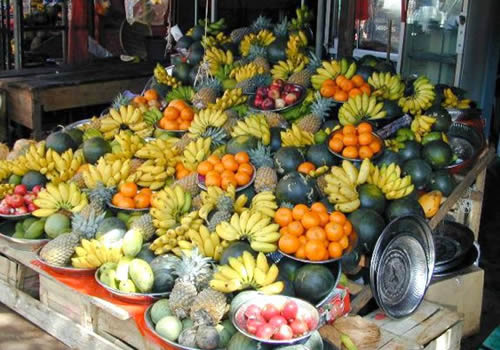
Kataragama is a small town with clean, tree lined roads with rows of
stalls selling garlands & platters of fruit-coconut, mango watermelon.
The city, town & the wide shady roads are developed by the late
president-ever industrious workhorse-indomitable R. A. Premadasa.
The best time to visit
The town is at is best bold, bright & busiest during the Kataragama
festival, held around the Kandy Esala Perahera pageant in
Kandy - two weeks in July & August.
The Journey
Kataragama is easily visited as a day-trip from
Tissamaharama. A night's
stay at Kataragama provide the opportunity of enjoying the sight of the puja (ritual offerings) in a leisurely manner, you may also imbibe some
of the town's backwater charm & laid-back rural pace.
The setting
Kataragama town spreads out over a small grid of tranquil, leafy
streets. The town is separated by the River Menik Ganga ("Gem River")
with Sacred Precinct to the north, an area of beautiful parkland overrun
by a grey langurs.
The popular river at Kataragama, Menik Ganga (River of Gems)
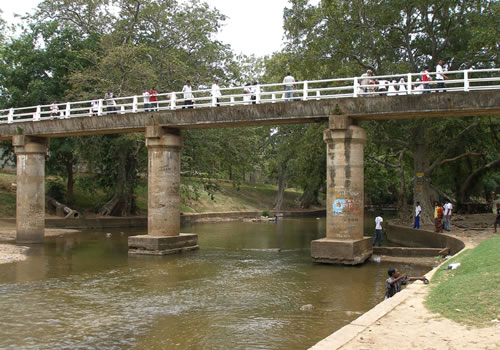
A short walk from the car park takes us to popular river Menik Ganga
("River of Gems"). We cross the bridge & then steps lead us down to the
river which is quite shallow in places. It's a nice & easy river for a
leisurely bath(village style) anytime during the day. The area around
the river is very attractive with large trees on the banks providing
plenty of shade. Pilgrims enjoy their ritual bath in the middle of the
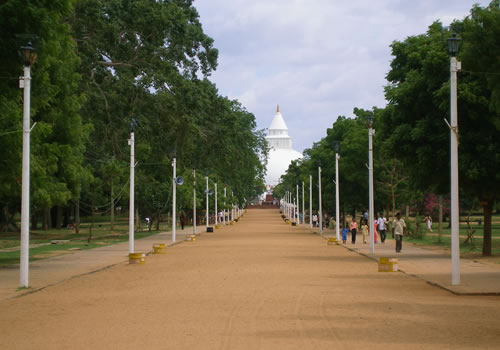
river. We cross the bridge to enter the main temple complex. The 300m
wide avenue lined with trees leads us to the Hindu temple.
The legend & the history
According to the legend, victorious King Dutugamunu (161-137 BC) built
the original shrine following his series of long battles against the
mighty forces of Dravidian invader, Elara, at
Anuradhapura. The legend
is God Kataragama helped King Dutugamunu's formidable Sinhalese army to
cross the River Menik, which would have been an unassailable mighty
river a couple of millennium ago. The history is (Mahawamsa) King
Dutugamunu's army was commanded by ten mighty warriors, Nandhimitta,
Suranimala, Mahasona, Gothaimbara, Theraputtabhaya (formerly a Buddhist
monk, he gave up the Buddhist order for the sole purpose of saving the
Sinhalese & Buddhism from the marauding Dravidian invaders), Bharana,
Velusumana, Khanjadeva, Phussadeva & Labhiyavasaba, all of them of
superhuman strength & courage sans Achilles heel. Those ten mighty
ambidextrous warriors of great strength & courage were ably assisted by
great battle elephants. Foremost in strength, beauty, shape & the
qualities of courage & swiftness & of mighty size of body was the royal
elephant Kandula, who broke open the mighty door of impregnable
Dravidian fortress at Vijithapura (city of victory),
Anuradhapura.
The sacred pilgrimage site of the benevolent god
To Buddhists, this forest sanctuary is where the Buddha planted a
sapling of the Sacred Sri Maha Bodhi tree of Anuradhapura, sanctifying
the spot. To Hindus, Kataragama is the domain of the Hindu war god
Skanda. Both Hindu & Buddhist communities believe that Hindu war god
Kataragama (Skanda) has the power to intervene benevolently in their
affairs & thousands, convinced of the deity's benign influence, journey,
to Kataragama for a puja (offering) at the time of embarking on a new
venture. But then again it is said "the god help those who help
themselves" you better have the moral courage & will to realize your
dreams. Those who have the will would find a way. May god also go with
those who toil in the High Noon for a Few Dollars More without the
lady-luck of McCanna's Gold. And may the adored, benevolent god have
mercy on all those Good, Bad and Ugly too. And may the god bless the good
guy who wrote this. Amen!
The ritual
The ritual traditionally involves a bath in the Menik Ganga (The River
of Gems), the wearing of clean white clothes & then a walk of several
hundred meters along the wide avenue to the temple, bearing offerings of
flowers & fruit. Each supplicant light a coconut, then holding it aloft
while saying a prayer, before smashing it on the stony ground, hoping
for it to split into two nice halves-auspiciously open-a good omen.
It's considered inauspicious if the coconut fails to split on the stone.
Offerings are made to the god inside the shrine.
Temple Complex
The first building we'll encounter is the Ul-Khizr that houses the tombs
of Muslim saints from Kyrgyzstan & India. It is a beautiful small mosque
with coloured tile work & wooden lintels. Next to the Muslim Ul- Khizar
is Hindu temple of God Shiva. We continue up the main avenue, passing a
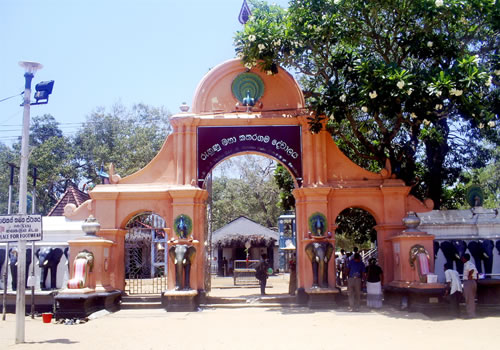
string of minor shrines, to reach the main shrine, the Maha Devale. The
main courtyard is surrounded by an impressive wall decorated with
elephant heads, & is entered through an ornate metal gate. The wall as
well as the gate is decorated with peacocks, a symbol of the God
Katargama.
The Maha Devale (The main Shrine) inside the temple complex
Inside are three main shrines.
Directly opposite the entrance gate is the principal shrine, that of God
Kataragama, a simple quadrangular white building with carved wooden
doors & walls decorated with pink lotuses, green Bo leaves & elephants.
The shrine is believed to contain the spear of the multi-visaged,
12-armed warrior deity.
The other two shrines are dedicated to God Vishnu, one of the supreme
Hindu deities, & the elephant-headed God Ganesha, the god of prosperity
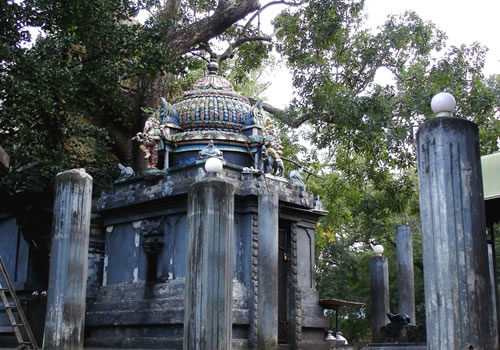
& wisdom. To the side of three shrines stand two fine Bo trees, the
larger surrounded by golden rails & an elephant wall.
God Kataragama
Skanda, the Hindu god of war, aka Karthika Kumara, Shuba, Mahasena,
Devasena, Kadira, Agnibhuwa, Shanmukha, Kartikama, Murugan & Subramanya.
The god is said to have come to the island to fight an enemy of the gods
& having defeated the demon Tharaka at Velapura, today's
Kalutara,
settled down at Kataragama. The Hindu war god in spite of six-faces & 12
arms doesn't look dusky & ferocious at all. If anything, he is fair &
handsome. And he is pleasant to the boot. It is said he is bit of a
Romeo too, a hero to the damsels in distress. Once he got his brother
God Ganesh himself to create a distress to the damsel Valli, so that he
could emerge at the nick of the time in grand style & save her with
great valour & become her one & only hero. But then, to give the devil,
sorry, god his due credit, we must hasten to add, the handsome god
married both the girls, Walli & Pulli. Since monogamy is nothing but
dull monotony (not let her hear!), the god seemed to have opted for
bigamy. Polygamy is bound to become a hell of a headache even with a
single head, not to mention six heads as of God Kataragama. But then,
how would you know of divine endowments & faculties? They say divine
ways are behind the means of mortals. Indeed! Indeed!
Archeological Museum
Next to the Maha Devale, the modest Archeological Museum features Buddha
statues, moonstones, ancient inscriptions, huge fiberglass replicas of
religious sculptors from various places in the island, along with other
bits of religious statuary & paraphernalia-conch shells, stone
figurines.
The Long walk to Kataragama (Pada Yatra)
Forty-five days prior to the beginning of annual Kataragama Festival on
the Esala poya (full moon), groups of Kataragama devotees embark on the
pilgrimage called Pada Yatra to Kataragama walking the length of Sri
Lanka. The route follows the east coast from the Jaffna peninsula via
Trincomalee & Batticaloa to Okanda, then through Yala East & Yala West (
Ruhuna Yala National Park ) to Kataragama. It's an arduous trip, & the
pilgrims rely on the hospitality of the communities & temples they pass
for their food & lodging. The pilgrims believe they are walking in the
steps of the god Kataragama. Most of the today's visitors, however, come
by the buses, vans & cars.
Thaipusam Festival
Conch shells blow, trumpets blare & drums beat out as voices rise in
unison to a chorus of chant of Haro Hara; elephants parade, drummers
drum & vows are made. Some devotees seeking favours demonstrate their
devotion to the god by performing extraordinary acts of penance &
self-mortification: tongues & cheeks are transfixed by spikes, or
butchers' hooks penetrating their skin. Some devotees are suspended up
in the air by an array of hooks & mounted on ox-driven carts swing forth
& backwards freely; others roll half naked over the hot sands near the
temple. Parades of pilgrims take part in vibrant & vigorous Kavadi
(peacock) dance: men, women & children holding decorated semi circular
red arches made of wood & paper above their heads dance to the beat of
drummers & trumpeters.
The fire-walkers who had prepared themselves for the festival by acts of
fast, meditate & pray for the last few weeks, at the end of the
festival, take a ritual bath in the Menik Ganga & pay homage to the god
Kataragama at the Maha Devale. Then they step out onto the glowing beds
of red-hot-cinders-while the audience cries out encouragement.
The festival ends with the ceremony of water cutting: the waters of the
Menik Ganga are 'cut' with a sword, at the moment of the full moon,
symbolizes the separation of pure from impure & the invocations of rain
for the harvest.
Kirivehera
Beyond the Maha Devale is a meeting hall on the north side of the
square. From the east gate, a Tulip tree avenue leads 500m past further
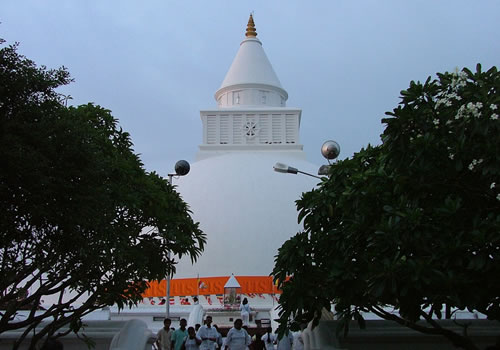
lines of stalls selling lotus flowers to the Kiri Vehera dating from 1
BC. It is a milk white large stupa with a well maintained & peaceful
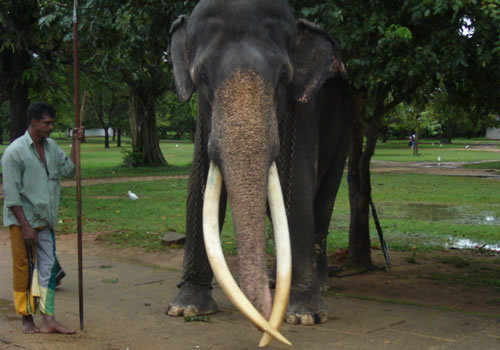
courtyard. The temple elephant is often seen shackled to the trees here,
being fed a copious diet of palm leaves. Its only unusual feature being
the two sets of square walls which enclose it. A modern statue of King
Dutugamunu stands behind the dagoba.
Vadihitikanda
While Kataragama is the domain of the benevolent god, it is believed the
precise abode of the god is a mountain called Vedihitikanda (meaning
mountain where the god settled in)
situated 5km from the town of Kataragama. Walking up to the summit of
the mountain is tough yet enjoyable.
Sella Kataragama
Located 5km from Kataragama is the small town of Sella Kataragama. The
tree lined, well sheltered road make the drive pleasant. Sella
Kataragama is the place where god Kataragama first met his first consort
Valli Amma.
Devale shrines located in other parts of Sri Lanka associated with God Skanda, the deity of Kataragama
Vallahagoda
The ancient devale shrine located at 3km from the Gampola railway station at the village of Vallahagoda of Ganga –ihala Korale, Udapalata, Gampola, Kandy district is dedicated to Skanda, the god of Kataragama. It is believed that the shrine was built by King Bhuvanaikabahu the fourth. According to a narration of the book Ceylon by H. W. Cave, the figure of mythological beast Gajasimha (Sinhala: Elephant lion) brought to the shrine from the palace of the King Bhuvanaikabahu the fourth.
Vagama Raja-Maha-Vihara
Vagama Raja-Maha-Vihara is located at 5 km off Upper Hevahata, in the area of Rahatungoda, Gannava Korale, Uda Hevahata, Gampola, Kandy district. Vagama Raja-Maha-Vihara is associated with the legends of Skanda, the god of Kataragama.
During the reign of King Vikramabahu the third, a drummer at the village of Ramagama of Gampola of Kandy district, having reached old age found it impossible to pay further visits in homage to the shrine of god Skanda at the village of Kataragama of the Deep South of Sri Lanka and prayed in search of a solution. It is said the God Skanda revealed himself in a dream intimating a miracle would take place in the village of Amnakka guiding him to solution. The miracle took place at the Ambakka flower garden of the Queen Henakanda Biso, the queen of King Vikramabahu the third (1356-1371 AD). While clearing up thorny bushes in the flower garden, the gardener found a Kaduru tree (Botanical name: Dogsbane apocynaccae) pouring blood at a stroke of his axe. The drummer arriving at the garden revealed his dream. The story of the Kaduru tree pouring blood and the dream of the drummer spread like wild fire all over the kingdom of Gampola to reach the ears of King Vikramabahu the third. The king having arrived at the garden had a shrine built on the location in veneration of the God Skanda, the deity at Kataragama.
The legend of opapatika birth (Sinhala: birth of a human without human parentage); the exceedingly great beauty; the ascendance to royalty; the untimely death at the hands of God Skanda, the deity of Kataragama; the elevation to divinity of Queen Henakanda Biso Bandara consists of extraordinary episodes.
During the period of the kingdom of Gampola, the incumbent at the Buddhist temple at the village of Beligala ( Sinhala: Rock of Beli trees) of the Gampola was intimated in a dream that a human infant was born with no human parentage, in fact in a Beli fruit, and it was his destiny to bring up the child. Beli (Aegle marmelos), a sacred tree in Hinduism, is used in Hindu rituals in worshipping God Shiva. Having taken the dream with due reverence, a Beli fruit of great proportions was removed from a Beli tree in the premises of the Beligala Temple and deposited in a safe chamber of the Beligala Buddhist temple. One night a great noise as of thunder was heard within the temple itself. Following an inquiry, it was found that the Beli fruit had burst open. A female infant of immense radiance and beauty was seen inside the Beli fruit: The infant Venus brought onto the earth in the Beli fruit accompanied by the sound of thunder, was named Henakanda (Sinhala: sound of the thunder). The infant grew up to be a maiden of supreme beauty. Having rejected all her suitors, she finally became the Biso (Sinhala: Queen) of King Vikramabahu the third. Henakanda Biso also became a devotee of God Skanda, the deity of Kataragama. Kataragama deviyo (Sinhala: god Kataragama or God Skanda), in spite of his divinity, being tempted (he couldn’t resist the temptation, this time) by the exceedingly supreme beauty of her sultry serene Queen Henakanda Biso, would have no patience to see through the human life of hers and definite ascendance to the divinity in virtue of her merits. God Skanda had her killed by strangling in her palanquin at the village of Pusulpitiya. The God made her one of his goddesses. Following her death and ascendance to divinity, she was known by the name Henakanda Biso Bandara, Bandara being a title conferred on the local deities.
Taking the life of any being, in spite of conferring the divinity on the victim, being a sin, there is no gainsay in the fact that non other than God Skanda himself committed a sin herein. That is over and above the sin of coveting thy neighbor’s or rather our king’s wife. Over to you, God Skanda! By the way, I like your style, you have to get what you desire, at any cost. With due respect, love and devotion, my lord, the great warrior God King, your worship and warship wouldn’t let bunpeiris ever take a step a back in his humble endeavors. Grant me what’s my due plus, my lord. Amen.
Rosen Renaissance Hotel
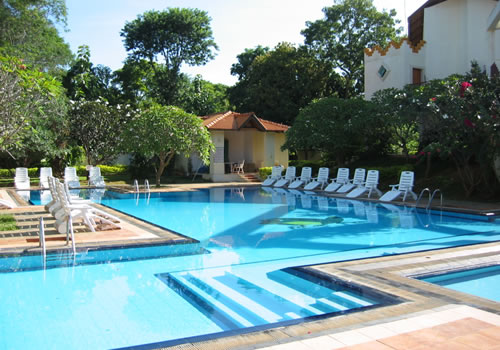
Detagamuwa, on the Tissamaharama (Tissa) road 2km out of the town. A
smart & stylish hotel with fifty a/c rooms come with all modcons
including satellite TV, minibar & safe: here's also gym, coffee shop,
games room & three swimming pools with underwater music. That's not The
Right Stuff for self-abnegating pilgrims. That's for the tourists, local
as well as foreign.
North of Kataragama
North of Kataragama is popular Ruhuna Yala National Park.
Kirinda
Situlpahuwa monastic settlement
Maligawila