The importance of conservation of the park
Horton Plains National Park, a World Heritage Site perched on the southern edge of the
Central highlands, midway between
Nuwara Eliya &
Haputale consists of montane forests, where the land rises to 2,500 meters above sea-level. Horton Plains is home to an extraordinary range of flora and fauna, including several endangered species such as the
western-purple-faced langur, the
Horton Plains slender loris and the
Sri Lankan leopard. The region is considered a
super biodiversity hotspot. The Park (10,000 ha), named after British governor Sir Robert Horton is a world apart from rest of the tropical island. This is the island's highest & most
isolated plain, a result of millions of years of erosion. The importance of conservation of the park lies in, among others, in its role as the
catchment area of the major rivers of the island.
The early morning drive
The high altitude plains are beautiful, silent, strange & excellent for trekking & bird watching. A light sweater & stout shoes for the morning;
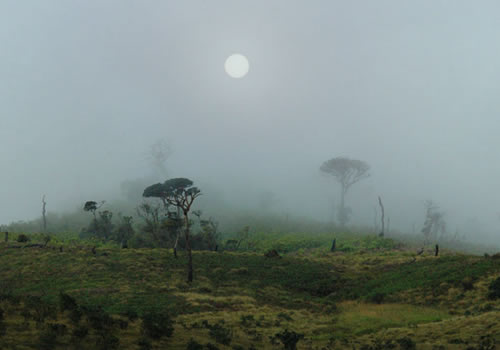
a hat & sunscreen for mid day. The weather can change very quickly on the plains. One minute it can be sunny & clear, the next chilly & misty.
Pastries & sandwiches. canteens of water, a flask of tea or a flask of coffee. We will be leaving as early as 5.30 am from
Nuwara Eliya. The drive from here on via beautiful Diyatalawa (of military cantonment
since the days of the British) to Horton Plains is particularly beautiful. Mountains, mist, tall trees, green vegetation, flowers &
fruits all hugging you all along. The crisp & cool air would be wrapping you around. The pain in the A of waking up, getting up & getting ready
early in the morning is all gone now. You start to feel assured that all that trouble is nothing compared the ride, hike & the park. This is hill
country of Sri Lanka. Just before we reach the park we drive passing a stunning dawn view of
Adam's Peak. The peak is prettiest during the
pilgrimage season from December to May while the mountain is illuminated with lights). By 7 am we are at the entrance to the park.
Trekking in the morning
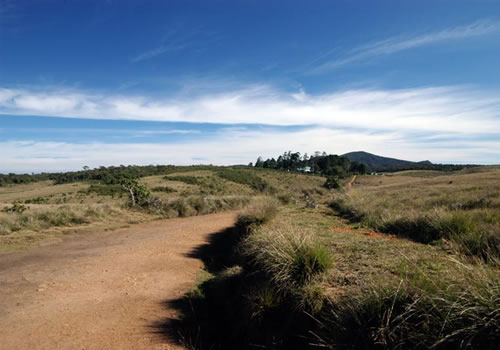
Now on it's the trekking. A 9.5 km circular track (round trip entrance to the park /the World's End/ Baker's Falls/Entrance to the park) around
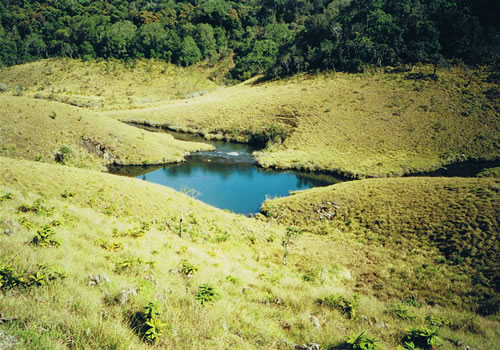
the plains. The crystal-clear pools still run with trout, a legacy from colonial times. Shallow streams run over pebbled beds.
Scottish moorlands
The breathtaking landscapes of this high, misty, silent, strange plateau, some 20 km (12miles) south of Nuwara Eliya & up to 2400m (7870
ft) above combines bleak, windswept, high altitude mountain grasslands similar to Scottish moorlands of Emily Bronte's "Wuthering heights" with
areas of miniature "elfin" forest-dwarf forms of tree & shrubs adapted to the cool climate & skimpy soil of plains. A blend of temperate
montane forest & wet patina grassland. For the first half of a kilometer, the path leads through rolling open land dotted with gorse &
rhododendron bushes before entering a stretch of wonderful cloud forest: a tangle of stunted grey-barked trees & shrubs are draped in lichen &
bog moss (sphagnum). This is a Tolkienesque imaging.
Montane forest
The prominent canopy tree of the montane forest, the umbrella-shaped, garnled Keena (
Callophylum) with its white flowers contrasting with the
striking scarlet rhododendrons (
Rhododendron zelanicum) leads you on. Among other flowering plants are Aristea ekloni which has tiny blue
flowers & Exacum macranthum, which are similar. Bamboos, tree ferns & many endemic species of plants make the park a biological treasure
trove. Vegetation includes a type of tufty grass called Crosypogen. The forest also contains an extraordinary shrub called Nillu (
Strobilanthes)
that flowers once every five to 10 years. But as there are many populations of varying ages, there are always some in bloom during the
season. The sight & smells of a large purple-leafed Nillu flowering & fruiting attract an amazing diversity of animals to the area, from birds
to bears.
Bird watching
This is one of the best places in the island for bird watching. Montane endemics include Sri Lanka white eye, Sri Lanka wood pigeon, Ceylon hill
munia & dull-blue flycatcher. Others are Indian blue robin, grey-headed canary flycatcher, pied bush chat, black bulbul, bar-winged
flycatcher-shrike & Indian scimitar babbler & Sri Lanka junglefowl. And birds of prey include the mountain hawk eagle.
The deer
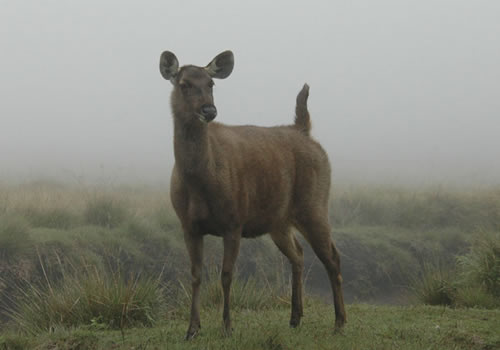
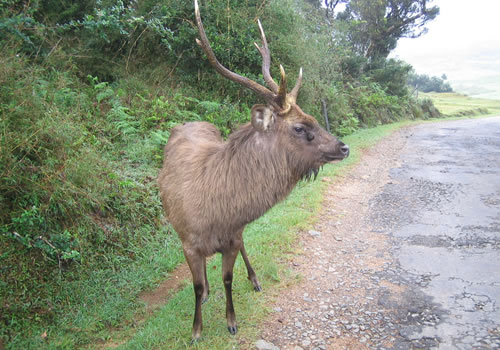
This is home to Sambar deer which keep to the edge of wooded areas. The shaggy bear-monkey (or purple-faced langur) & giant squirrel. Here large
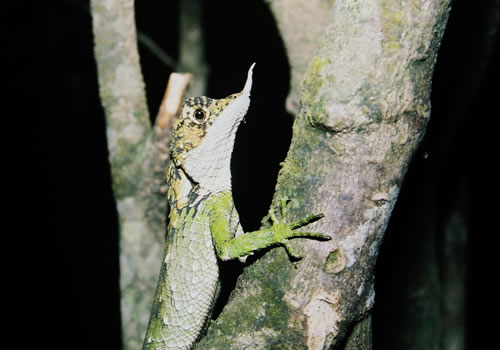
herd of Elk, silhouetted against the clouds of the lowlands, move among scarlet rhododendrons. This is also home to the rhino-horned lizard, a
rare relic species. Some lizards with outlandishly fluorescent green scales is also seen.
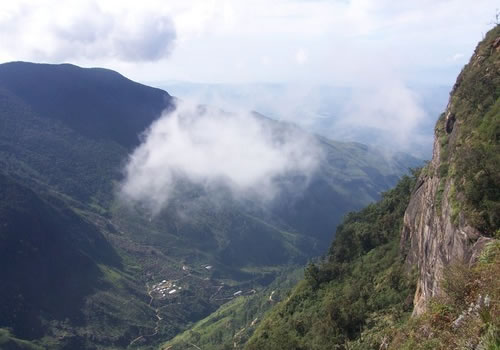
The cliff plunges almost vertically for 700m, creating an astonishing escarpment, revealing breathtaking views across much of the southern
area of the island. The whole panoramic view is right in front of your naked eyes. If you dare to peep at the base of the cliff, you will be
lying down on your tummy, on the cliff close to the edge & inch towards the very edge while your lover hold your feet with both hands. Then
again, that is only if you trust your lover with your life, eh! (Not let her hear, for heavens sake). If that is not the case, there is no option
except your Mummy. Take it with a pinch of salt & we will be right at your service, at your feet. Holding your feet in vice like grip, trust
me. Relax. This is where Monica & her lover leapt to death (their families were at loggerheads, or to be precise, swords drawn at each
other's... they used to shake spears... that rings a bell???) triggering a chain reaction of no less than ten star-crossed couples. The top ten
couples of lovers of Sri Lanka also remind us of Crown Prince Saliya (137 BC.) (son of King Dutugamunu, hero of 2550 years of history of Sri
Lanka), who deserted the right to crown to be in his own oasis with his Aiyshwarya like lover, Asokamala. You will see the beautiful rock statue
of the couple at
Isurumuniya.
Marvellous views
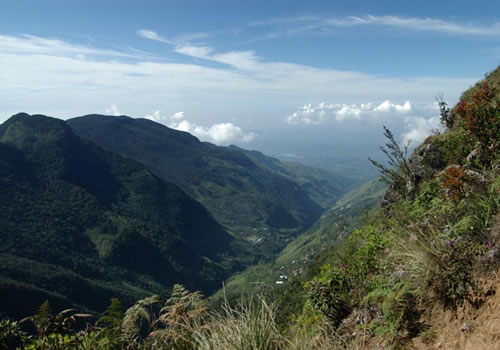
Along the marvellous views of craggy peaks, which forms the southern boundary of the hill country, are Sri Lanka's second & third highest,
Mount Kirigalpota (2395m) & Mount Totapolkanda (2359m), which stand at the edge of the park. The large lake in the near distance is man-made
rainwater reservoir. In the farthest distance, we can see the southern coast. It's exhilarating to view through such a range with your naked
eyes. As the crow flies, or rather as the bullet completes its range - direct distance from where we stand to the southern coast is about 75km.
Still it is 8 a.m. Our early departure at 5 a.m. from Nuwara Eliya (Little England, set against beautiful backdrops of Mountains, Valleys,
Waterfalls and Tea Plantations) is justified. By 10 am there would be mist shrouding the slopes below & there would be white wall of mist, we
wouldn't see a ball, even the short range. A track down to a valley & 2km walk leads us to a small-forested escarpment. A climb & then a
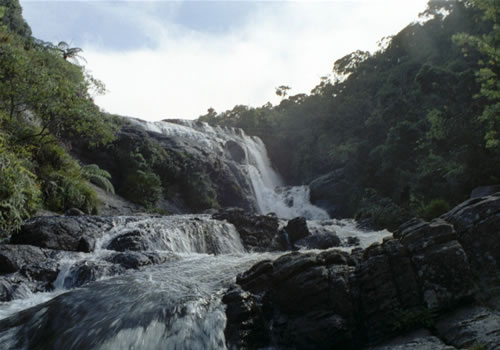
slippery descent take us to the picturesque Baker's Falls. The water herein is deliciously cool & refreshing. From Baker's Falls it is an
easy 3 km walk back along the river, passing an attractive Governor's Pool. We will be paying the entrance fees on our way out since the
ticket office wasn't open when we entered at 6 am.
Slender Loris [Sinhala: Unahapuluwa] reappears in Horton Plains.
The Horton Plains Slender Loris, considered the rarest primate, a small social and nocturnal species threatened by loss of habitat (fragmented forests need to be reconnected), which had only been seen four times during 1937 and 2002 and believed to have become extinct, was sighted and captured on camera by a team of Conservation biologists consisted of members of Zoological Society of London (ZSL), students of University of Colombo and the Open University of Sri Lanka on 18th July 2010. The rediscovery was a result of an EDGE Evolutionarily Distinct and Globally Endangered project- a conservation initiative dedicated to raising awareness about the plight of animals on the brink of extinction. According to ZSL Conservation Biologist Dr. Craig Turner, it was the first close examination of a Horton Plains Slender Loris ever conducted.
The Horton Plains Slender Loris, a subspecies of the Red Slender Loris (Loris tardigradus) found only in the tropical forests of Southern India and Sri Lanka, is classified in terms of endangerment and evolutionary distinctness for the mammals of the world Red List by the IUCN International Union for Conservation of Nature. The Horton Plains Slender Loris having shorter and sturdier fore and hind limbs than those of any other Slender Loris (so named owing to its long, slender arms and legs) in either Sri Lanka or Southern India is a telling indication of how the mammal has adapted to living in the cool montane highland forest of Horton Plains in the Central Highlands of Sri Lanka.
Horton Plains is declared a World heritage Site by UNESCO.
Horton Plains National Park (HPNP) was recommended for the tentative listing of
World Heritage Sites (WHS) to United Nations Educational,
Scientific & Cultural Organization (UNESCO) by the Ministry of Environment and Natural Resources of Sri Lanka on 20th March 2006. On 30th July 2010 UNESCO declared Sri Lanka's Highlands comprising
the Peak Wilderness Protected Area, the Horton Plains National Park and the
Knuckles Conservation Forest, a World heritage site..