 |
 |


|

|
||||||||||||
Sri Lanka Holidays |
Home | Nature/Adventure | Ancient Glory | Rich Package | Sri Lanka Holidays | Total Holiday Experience | Travel Guide | Lanka History | Hotel Guide

|
||||||||||||||||||
|
Home | Nature/Adventure | Ancient Glory | Rich Package | Sri Lanka Holidays | Total Holiday Experience | Travel Guide | Lanka History | Hotel Guide |
|
|||||||||||||||||
|
 |
The Sacred City of Anuradhapura, Sri Lanka(Greatest monastic city of the ancient world, 437 BC-845 AD, a World Heritage Site)
Anuradhapura and the city of Polonnaruwa are the vitally important "must visit" twin tourist attractions of Sri Lanka Holidays Cultural Triangle. Anuradhapura, the greatest monastic city of the ancient world that date from the middle of the 5th century B.C. remained the proud seat of kingdom of Sri Lanka until the 11th century A.D. Today Anuradhapura, a UNESCO World Heritage Site, is replete with renovated monuments, restored edifices, preserved ruins and historical sites where the archeological excavations are still being continued. Today, Sri Lanka Holidays foreign tourists and local tourists, who tour Anuradhapura, are simply unable to witness everything Anuradhapura has to offer, within the confines of a single day as Sri Lanka Tours have been cram-programmed. However the major attractions of Anuradhapura can be visited in a single day.
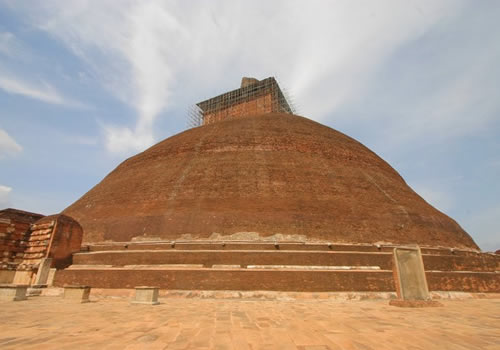
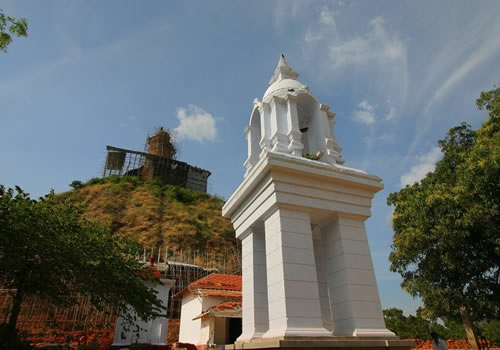
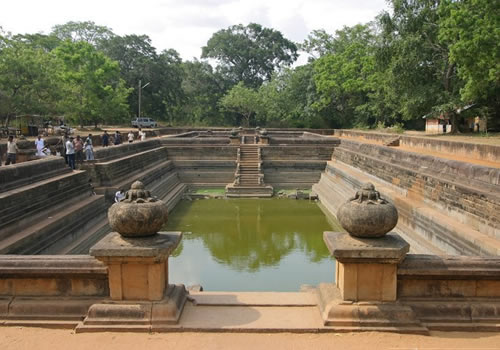
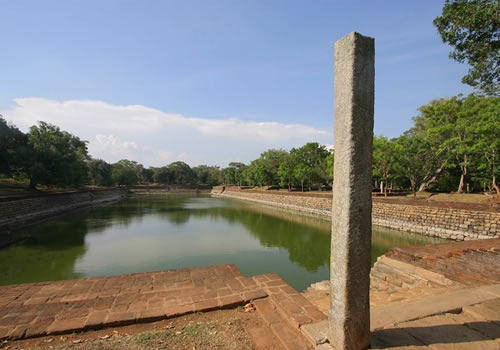
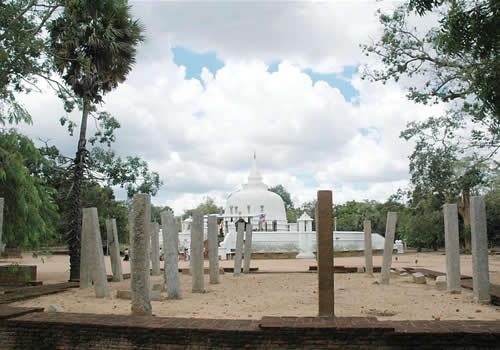
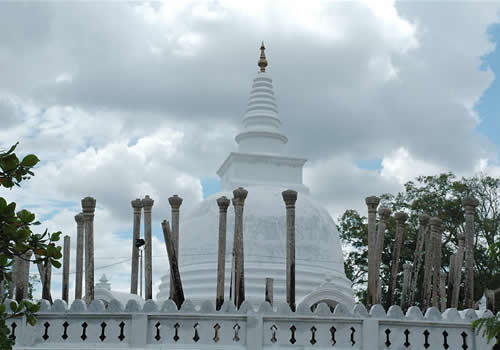
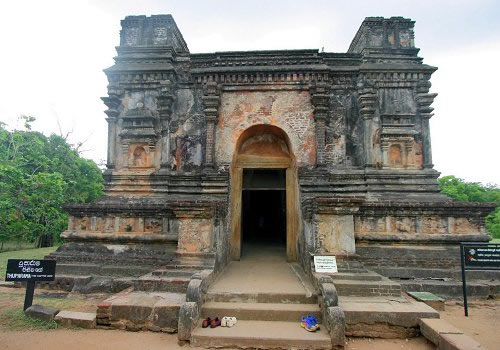
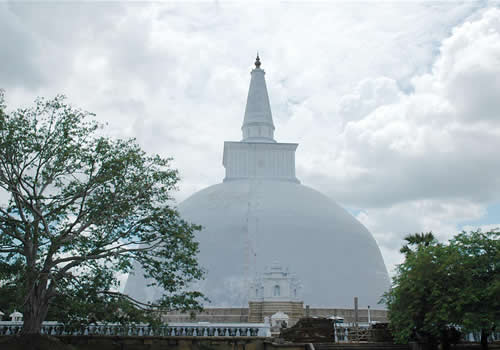
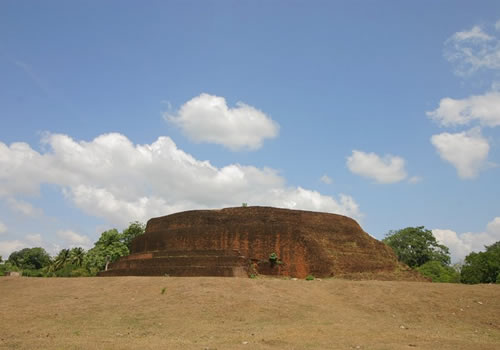
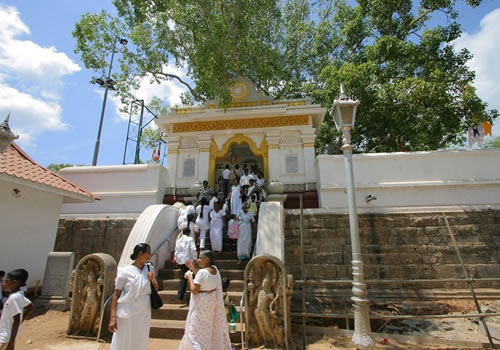
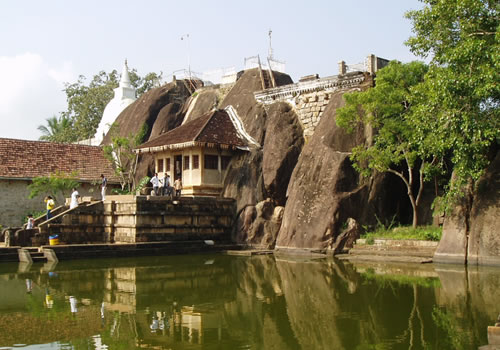
Anuradhapura was the cradle of glorious Sinhalese Buddhist civilization. The pride of place in Anuradhapura was taken by the ancient stupas and ancient reservoirs. Towering stupas (dagobas) of stupendous domes, the marvels of ancient civil engineering, were built having taken into the account the effects of lightening on high rise constructions, among numerous other engineering factors. The vast rainwater reservoirs built by crossing rivers with enormous dams and controlling the outlets with "Bisokotuwa" (Sinhala: Queens enclosure-no entry, of course) valve pits (sluice gate), extend lifeline to Anuradhapura district to date. Among the other tourist attractions at Anuradhapura are magnificent rock carvings of monumental richness and remarkable grace; colossal stone pillars that stand proud amidst the ruins of royal palaces, Buddhist monasteries and temples; magnificent stone cut swimming pools of sophisticated hydrology. The splendors of ancient Anuradhapura was narrated in great length by Fa-Hien, the famous Chinese Buddhist scholar pilgrim, who spent two years in Anuradhapura copying the Vinaya Pitakaya (Sinhala: Book of Discipline) of Theravada Buddhism at the end of the 4th century. The Roman historian Gaius Plinius Secundus (23 AD - August 25, 79 AD) has recorded the descriptions of the city of Anuradhapura made by Annius Plocamus, who had visited Anuradhapura during the reign of Sinhalese King Sadamuhunu (Chanda-Mukha-Siva) (44 AD- 52 AD). Sir William Colebrooke narrates of Anuradhapura "I saw here here ornamented capitals and balustrades, and bas reliefs of animals and foliage. I cannot better express my opinion of their elegance than by saying that, had I seen them in a museum, I should, without hesitation, have pronounced them to be Grecian or of Grecian descent. One semicircular slab, at the foot of a staircase, is carved in a pattern of foliage which I have repeatedly seen in works of Greek and Roman origin. This flourishing state of art proves wealth and taste, and there are enormous conical buildings of brick, called Dagobas, whose Egyptian dimensions and durability show that they must have been built by a numerous and laborious race. The immense tanks, of which I saw the ruins, and by which the country was irrigated, were the cause of its permanent fertility so long as they were kept in repair." Colebrooke, Sir William Macbean George (17871870), 1832 Life-line: Great Ancient Man-made Lakes (Rainwater Reservoirs) Renovated Stupas, Ruins of Stupas, Monasteries & Temples. We mustn't fail to see: Glorious Ruwanweliseya Stupa, Serene Samadhi Buddha Statue, Enormous Jetavana Dagoba, Isurumuniya Rock Temple, Sacred Sri Maha bodhi tree. Sri Lanka's northwestSri Lanka's northwest (of which Anuradhapura is a major city) also known as the dry zone is arid, rolling, open country coloured in shades of dusty brown earth and golden ripening rice fields. Farming here depends on artificial irrigation, and the countryside is dotted with great ancient artificial reservoirs to retain rainwater and allow crops to thrive through the dry season.Three great rainwater reservoirs & River MalwatuThe ancient city of Anuradhapura is surrounded by three great man-made lakes, Nuwara Wewa reservoir to the east & Tissa Wewa reservoir together with Basawakkulama Wewa reservoir to the west with two directions of the city being defined by River Malwatu Oya that flows through it. We have Anuradhapura new town to the east of the river & sacred ancient city to the west of the river. It cannot get any better.History of Anuradhapura (WHS)From the origins as a settlement by Minister Anuradha in the 6th century BC, Anuradhapura was developed at a rapid pace & was made the capital of the island by King Pandukhabaya (437-366 BC), who took a leaf out of the book of King Abhaya (474 BC), the builder of the first rainwater reservoir of Lanka. King Pandukhabhaya commenced the irrigation schemes in a larger scale providing the lifeline to the fledging Aryan civilization of the Sinhalese. By the mid-3rd century BC Anuradhapura's fame for the excellence of its temple art and palace architecture, the ingenuity and skill of its irrigation engineers, noble elephants, precious gems, fine spices and its military prowess had spread as far as the Roman-Hellenistic world.The greatest monastic city of the ancient worldIt was not only one of the most stable & durable political power & urban life in South Asia, but also the greatest monastic city of the ancient world, the cradle of the island's temporal & spiritual power. The city attained its highest magnificence in the beginning of the Christian era. At the height of its glory, Anuradhapura ranked beside Nineveh & Babylon in its colossal proportions - its four walls, each 26 km long, enclosing an area of 663 sq. km - in the number of its inhabitants, & the splendour of its Buddhist shrines & public edifices.The Stupas second only to great pyramids of Khufru & Khafra at GizehThe temples & monumental dagobas, amongst greatest architectural feats of its age, have been surpassed only in scale by the great pyramids of Khufru & Khafra at Gizeh. Jetavana Dagoba, Abayagiri Stupa & Ruwanweliseya Stupa.Crowning glory: Agricultural prosperityTogether with stupas, temples & monasteries of Buddhism, the crowning glory surfaced: irrigation. Colossal rainwater reservoirs were constructed by way of man power & at once the bulldozer & bulldog of the nation, elephant. With the concept of saving rainwater by means of reservoirs, the island became self-sufficient in rice, the staple diet of the Sinhalese. Almost all of these tanks have been restored & even to date provide the lifeline to farmers, the irrigation of the province.Great man-made rainwater reservoirsSri Lanka Holidays Anuradhapura is of enormous irrigation and hydraulic achievements. Nuwara Wawe (7 km across) to the east, Tissa Wewa (spanning 65 hectares) & Baswakkulama Wewa to the west constructed to preserve the monsoon rains, supplemented with a system of sluices (valve-pit) (Bisokotuwa) were put in place to feed the thousands of smaller reservoirs that were built in the concept of "Ellangawa" (cascade of water) to keep the rice paddies productive. In the numerous minor irrigation networks, the systems provide water for irrigation, for domestic use & livestock, wildlife & recharge of groundwater while enhancing the village environment: multiple dimensions of the value of water.Basawakkulama Wewa reservoir spreading an area of 205 acres today was built by King Pandukhabaya [437-367 BC]. In the ancient time this reservoir was called Abhayavava. Tissa weva reservoir built by King Devanpiya Tissa [307-267 BC] could had been a smaller tank in the beginning. However it is believed, in the fifth century Basawakkulama Wewa reservoir was enlarged to accommodate waters of vast Kalavava [Kala Weva] reservoir built by King Dathusena [461-479 AD], father of Sigiri Kassapa or Kashyapa [479-497 AD], the builder of Sri Lanka Holidays Sigiriya Lion Rock Citadel. Nuwara Wewe reservoir, which was called Nakaravavai in the ancient times, was built by King Gajabahu [113-135 AD]. The world's first hospitals for the animals as well as to the humans: the gentle sway of BuddhismThe gentle sway of Buddhism, the concept of tolerance & doctrine of compassion, led the Sinhalese to build the world's first hospitals. The respect of right to life of all living beings, inherent in Buddhism, was to become a cornerstone of the Aryan Sinhalese civilization.The Roman connectionAgricultural prosperity brought in by ingenious irrigation engineering resulted in 1300 years of grandeur of the city of Anuradhapura, the mass of Roman coins found in excavations testifying to the city's fame that spread to Greece & Rome. The idea of Taprobane (Sri Lanka) as a utopia, which was to become commonplace among Roman writers, occurs first in Artemidorus of Ephesus (104-101 B.C) (as cited Pliny N. H. V11 2.30)The Chinese ConnectionBy the 1st century AD, the island had established trade and diplomatic links with China. The Jetavana treasures, unearthed over the past 20 years (some are now displayed in the Jetavanarama Museum, on site) show evidence of these links to east and west.The social fabric of the kingdomAnuradhapura was home to thousands of Bhikkus (buddhist monks) served by a large peasant & merchant population. Chinese Buddhist pilgrim Fa-Hsien, who came in search of Buddhist text in Anurdhapura as Buddhism was already in decline in India, had recorded the splendor of the city. He narrated that there were two major segments, namely wealthy merchants of Indian, Mediterranean & Persian origin & Sinhalese nobles living in richly adorned houses & city dwellers who were engaged in agriculture.Marauding Dravidian invaders from South IndiaYet the glory itself brought about the downfall of the great city. During more than a millennium of its history, countless South Indian invasions with a view to kill & plunder, laid waste to the land leading to its destruction. Marauding Dravidian forces of Rajaraja Chola of Southern India racked & ruined the great city in the 9th century AD. The Sinhalese capital then moved to Polonnaruwa. Although attempts were made to preserve its monuments following the overthrow and expulsion of the marauding Dravidians, Anuradhapura was never restored to its former glory since the kingdom was subsequently shifted to Polonnaruwa.Survival of the fittestAs at Polonnaruwa, Anuradhapura's secular buildings were built partly or entirely of wood, which has not survived the centuries, whereas the giant dagobas, made entirely of earth, brick and stone, still stand intact..Sacred Sri Maha Bodhi treeA sapling of the sacred Bo tree (Peepal) (Ficus religiosa) in the shelter of which Prince Siddhartha Gauthama attained supreme enlightenment & became Buddha was brought to Sri Lanka by Buddhist nun Sanagamitta, as a gift from her father, the Mauryan Emperor Asoka in the 3rd century BC. Today, the huge specimen of this Peepal has no rival to the claim of being the oldest recorded tree in the world. It has been guarded by an uninterrupted series of guardian monks since it was planted.Southwest of the sacred bo-tree, on the shore of the Tissa Wewa tank, are several other interesting monuments. Return to the sender (a sapling)Though the original Bo tree at Bodh Gaya in India was destroyed, Sri Maha Bodhi in Lanka survived. Cuttings from Sri Maha Bodhi in Lanka have been grown all over the world. A cutting of the sacred tree was sent to India to transplant at Bodh Gaya, next to Mahabodhi Temple complex, which is now in fine fettle.Loha Maha Prasada (Brazen Palace)All we have today is ruins of a vast building, next to the sacred tree. Founded by the hero of the nation, King Dutugemunu (reigned 161-137BC), it was once home to a community of 1000 Buddhist monks, whose duties included, among numerous others, tending the sacred tree too.1600 pillars are all that remains of the nine story monastery, each floor with 100 rooms, surmounted by a bronze roof. The whole building was decorated with silver and gems.Ruwanweliseya Stupa (Ruwan Weli Seya Dagoba)Anuradhapura Archaeological Museum The first of five new museums planned for the Cultural Triangle, the Anuradhapura Archaeological Museum, between the Brazen Palace and the Ruwanweliseya Stupa (Ruwanweli Seya), contains a range of exhibits discovered on the site along with explanatory displays. Among these is a model of the Thuparama Vatadage and a relic chamber from Mihintale. Thuparama VatadageThis shrine, immediately to the north of the Ruwanweliseya Stupa (Ruwan Weli Seya), is the oldest in Sri Lanka and contains the collarbone relic of Buddha, a gift from the Indian Emperor Asoka of India to King Devanam Piya Tissa of Lanka, who converted his kingdom to Buddhism. Originally built in the 3rd century BC, it has been extensively rebuilt over the centuries & most recently in 1840. It is ringed by columns which originally supported a circular roof.Royal Palace200m north of the Thuparama Vatadage, on the opposite side of the road are the ruins of the Royal Palace date from the 12th century AD, when King Vijayabahu the first made a last attempt to restore Anuradhapura back to its former glory and prestige. South of it is the ruins of a temple which may have been the first to house the sacred Buddha's tooth relic which now resides at The Holy Temple of the Tooth in Kandy.Jetavana Dagoba Abayagiri Stupa From China with loveSouth of the dagoba is the Abhayagiri Museum, a gift to Sri Lanka from China in honour of the 5th century Buddhist academic Fa Hien. The museum contains relics and archaeological finds illustrating the ancient connection between China and Sri Lanka. In AD 412 Fa Hien visited Anuradhapura and wrote an account of his travels.Ratna Prasada (Gem Palace)Northwest of the Abhayagiri Stupa are to be found the remnants of a 2nd century monastery palace of which only the mighty pillars, carved with naga (benevolent snake spirit) symbols remain.Kuttam Pokuna (Twin Ponds) located east of Abhayagiri DagobaKuttam Pokuna (Twin Ponds) at Anuradhapura built between the period of eight century and tenth century, among the surviving treasures of ancient landscape architecture of Sri Lanka, is the finest. It is believed that the twin ponds were built for the bathing purposes of Buddhist monks at Abhayagiri monastery at Anuradhapura. According to the published narration by the Chinese traveler Buddhist monk Fa Hien, there were 5000 monks in residence Abhayagiri monastery in the 5th century.Conservation of these magnificent twin ponds, of which the ancient name hasn't been discovered, was carried out by Department of Archeology of Ceylon in the years 1949 & 1953. Dr. Senerath Paranavithana, the foremost archeologist of Sri Lanka, during the restoration of the Kuttam Pokuna (Twin Ponds) had found small figures of fish, a conch, a crab and a dancing woman herein. Kuttam Pokuna or twin ponds have earned its recent name in view of its unique concept: the two ponds are constructed to form a single pond with two interconnected units aligned in north-south direction with a gap of 9 feet between them. The differences in architecture have revealed that the northern pond was constructed prior to construction of the pond to the south. Both Ponds Each unit are of same width in precise rectangles and they are built in perfect alignment within the rectangular boundary. The face, sides and bottom of both ponds were immaculately cut in granite slabs. The northern pond [smaller pond: length-91 feet; width-51 feet] Twenty stone cut steps embellished with a balustrade descends to the water level from the ground level. Supply of water to both ponds are done at the northern pond from the same source and same channel: water from underground spring flows into an enclosure built above the water level of the ponds. Filtration of water from mud and dirt is done therein. The enclosure controls and releases the water to the smaller pond through the mouth of makara (Sinhala: dragon) sculpted in stone which, has a five hooded cobra sculpture also cut in stone below it. The water to the southern pond [larger pond] is supplied by the small pond through a duct that runs below the ground level connecting the two ponds. The southern pond [larger pond: length-132 feet; width-51 feet] Eighteen stone cut steps in three stages, each stage embellished with a balustrade leads to the water level from the ground level. The supply of water is made from the small pond through a duct that runs below the ground level connecting the two ponds. The drain of water (of both ponds) is done at a small outlet at this pond Samadhi Buddha Statue located southeast of the Abhayagiri DagobaSamadhi Buddha Statue, a serene image of a seated Buddha carved in granite that dates from the 4th century AD, is a masterpiece of ancient Sinhalese Buddhist sculpture found in Anuradhapura.The rediscovery of Samadhi Buddha Statue The Samadhi Buddha Statue was rediscovered, at the same location that it is now at Anuradhapura, in the year 1886: it was lying damaged on the ground with its nose sustaining a major damage. The hollow carved eye bore evidence those were formally inset with precious gems. The restoration of Samadhi Buddha Statue The statue was restored and re-erected. However the restoration of the damaged nose failed to do justice to its former beauty. The artistic concept of Samadhi Buddha Statue The statue in dhayana mudra [Sinhala: mode of trance] seated in virasna [Sanskrit: Hero Pose] is sculpted of dolomite marble. The archeological excavations done at the site revealed, the 7 feet 3 inches tall fourth century statue was the northern image of the four Buddha statues set in cardinal directions surrounding a Bodhi (peepal) tree that was once growing therein at Anuradhapura. Loha Maha Prasada (Brazen Palace)All we have today are ruins of a vast building, next to the Jaya Sri Maha Bodhi: 1600 stone cut pillars are all that remains of the nine story monastery. During the glorious days of Anuradhpura each floor of brazen palace consisted of 100 rooms and the building was surmounted by a bronze roof. The whole building was decorated with silver and gems. Founded by the hero of the nation, King Dutugemunu (reigned 161-137BC), it was once home to a community of 1000 Buddhist monks, whose duties included, among numerous others, tending the sacred Jaya Sri Maha Bodhi at Anuradhapura.Loha Maha Parsada also called Lohamahapaya or Lohapasada or Brazen Palace was built on the same location where Uposathaghara (Sinhala: chapter house) called Mahamucla malake built by King Devanampiya Tissa [307-267 BC] and consecrated by Arhath Mahinda for the Buddhist monks at Mahavihara Monastery. The great chronicle of Sri Lanka, Mahavamsa has left a vivid narration of the Lovamahapaya: "The four-faced mansion measured a hundred cubits on each side and in height too, it was as much. In this best of palaces, there were nine storeys and on each storey a hundred gables. All gables were inlaid with silver. Their coral railing was decked in different gems and surrounded by rows of little silver bells and their little lotuses were adorned with various gems" Page 580, The Great Chronicle of Sri Lanka, Mahavamsa, Chapters one to thirty seven An annotated new translation with prolegomena by Dr. Ananada W. P. Guruge [ISBN 955-20-8963-8] Lankaramaya StupaLankaramaya stupa located south-west of the Abhayagiriya Dagoba at Anuradhapura was built by King Valagambahu [Vattagamini Abhaya] [103 BC & 89-76 BC], the builder of Sri Lanka Holidays Golden Dambulla Rock Cave Temple at Dambulla. Though some historians claim the Lankaramaya stupa was named Manisosmarama as it was built in honor of the heroic consort Somadevi, who voluntarily dismounted from the chariot fleeing from the marauding Dravidian invaders to lighten the load: it was carrying the king, his two consorts [Somadevi and Anuladevi] and his son. Following fourteen years of refuge, recovery and reinforcement, the lion-heated king regained the kingdom of Lanka.The diameter of the renovated dagoba measures 38 feet. The circular terrace on which the stupa was built measures 132 feet. Four flights of steps, each with a width of 12 feet, oriented in cardinal directions, lead to the terrace, which itself is 10 feet above the ground level. During the glorious era of Anuradhapua, Lankaramaya stupa had a roof supported by 88 stone cut columns in the cetiyaghara (vatadage) architectural design at Polonnaruwa vatadage at Sri Lanka Holidays Polonnaruwa and Medirigirya vatadage and Thuparama stupa. Today only a few of the columns remain surrounding the stupa. Mirisavatiya Dagaba Royal Pleasure Gardens Also known as the Park of the Goldfish, these gardens testify to the skill of the architects and landscape gardeners of King Dutugemunu's reign. Covering approximately 14 ha (35 acres), they are built around ponds and rocks, with views over the Tissa Wewa tank, and were intended as a tranquil retreat from affairs of state. Some of that tranquility survives. Vijitapura Raja Maha Viharaya (Royal Temple at City of Victory)Vijitapura Raja Maha Viharaya is located close to great Kalawewa reservoir in the field where the hero of the nation, King Dutugamunu (161-131 BC), following a series of battles in numerous Dravidian strongholds through long 30 years, finally defeated Elara of Marauding Dravidian invaders & rescued the nation & faith. The victorious king allowed the defeated Dravidians to live in northern peninsula to where they fled: live & let live ideology of the Aryan Sinhalese. The gentle sway of Buddhism with its concept of right to life of all beings saved the marauding southern Indian Dravidians from being pushed into the Indian Ocean.Kadu Ge GalaKade Ge gala in the courtyard of Vijitapura Raja Maha Viharaya is the stone at which the thousands of swords of King Dutugamunu's army were sharpened during the great battle at Vijitapura.Isurumuniya Rock TempleThis rock temple, nicely built into the crevices between great smooth basalt boulders, is one of Anuradhapura's hidden secrets. It is well known for its sensual sculptures of embracing couples, indicating a culture which, while devout, was clearly not prudish. Dating from the 3rd century BC, it stands beside ponds above which the rock face has been carved with cheerful looking elephants at play.>Love conquers all, even the throne & kingdomMore stone carvings are on display at a small museum within the temple. Among the displays is a slab that shows two lovers seated side by side, Saliya (the only son of the hero of the nation, King Dutugemunu) and his wife Asokamala. Saliya met Asokamala walking in the Pleasure Gardens, fell in love head over heels and married her. As she was not of royal blood, he was obliged to forfeit his claim to the throne. |
|
|
Copyright 2007-2012 - All Rights Reserved by Riolta Lanka Holidays (Pvt) Ltd. Web Site Design by Web Crafts (Pvt.) Ltd. |