 |
 |


|

|
||||||||||||
Sri Lanka Holidays |
Home | Nature/Adventure | Ancient Glory | Rich Package | Sri Lanka Holidays | Total Holiday Experience | Travel Guide | Lanka History | Hotel Guide

|
||||||||||||||||||
|
Home | Nature/Adventure | Ancient Glory | Rich Package | Sri Lanka Holidays | Total Holiday Experience | Travel Guide | Lanka History | Hotel Guide |
|
|||||||||||||||||
|
 |
Kandy Esala Perahera pageant, Sri LankaThe most vibrant & colourful religious pageant of Asia
"Perpetual fire-laughing motion among the slow shuffle of elephants"-
D. H. Lawrence (1885-1930)
"All the senses have been constantly assailed throughout the long night's drama & the impact of this marvelous event is never forgotten. All who have witness this marvel have visited another world. It's unique & should not be missed" David Leask "There can be few festivals in the world to match the Kandy Esala Perahera pageant of Sri Lanka for passion & splendour." Evelina Rioukhina, UNECE
Periodicity: once a year
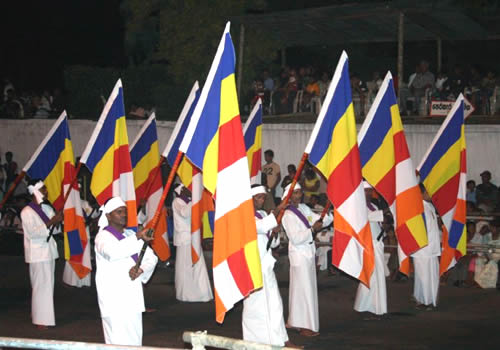
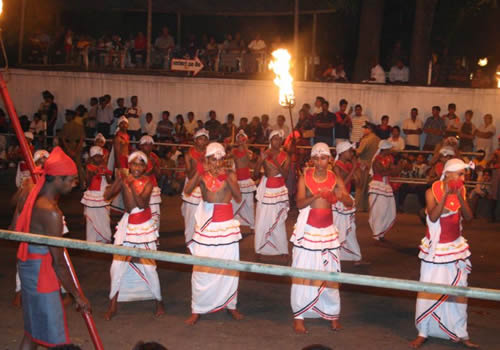
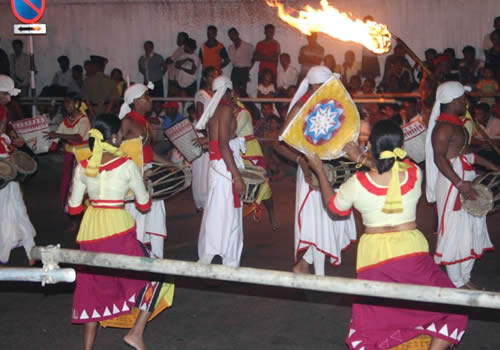
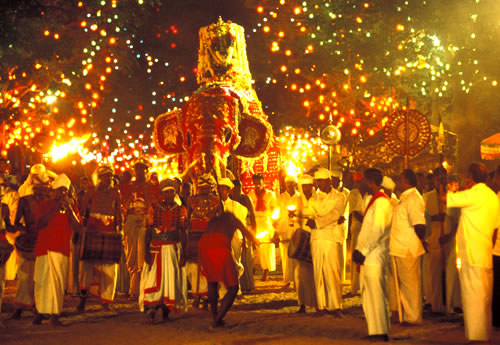
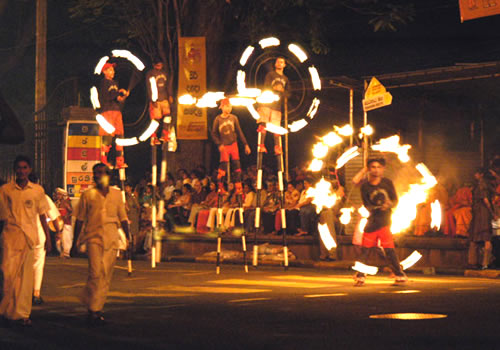
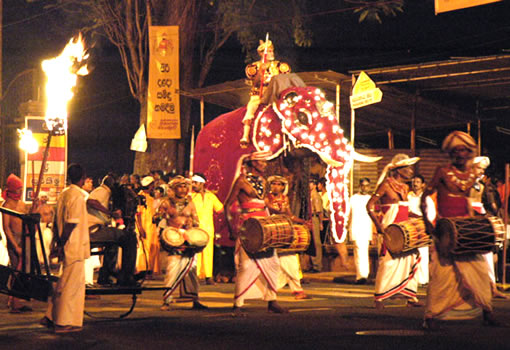
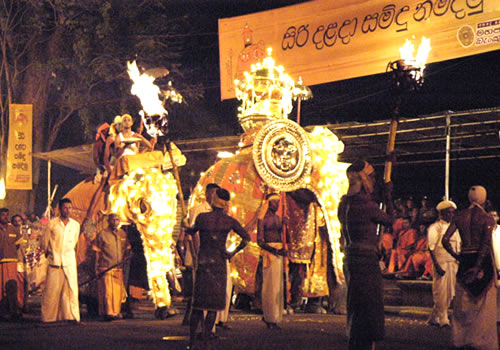
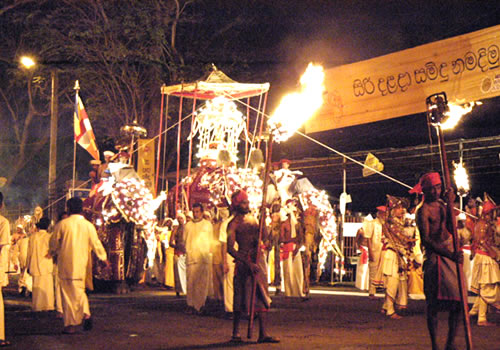
Period of the year: July/August (lunar month of Esala-of Sinhalese calendar) Duration: 10 days Time of the day: 8.30-11.30 pm Nature of the pageant: historical, cultural, aesthetic & religious. A medieval pageant with no spectator participation. Players only. Build up of the pageant: each night the pageant grows larger & larger until the final night (full moon) to about 5000 dancers, drummers etc & 100 elephants. Designated circuit: along the pre-determined streets in the city of Kandy, Sri Lanka Occasion: celebration of the arrival of Sacred Relic of Tooth to Sri Lanka during the reign of King Kirti Sri Meghawanna (304-331 AD), 500 years after the arrival of Buddhism to Sri Lanka during the reign of King Devanam PiyaTissa (307-266 BC), the famous "Deer Hunter". Significance of the great event: to give thanks to the gods in song, dance & pageantry for the harvest & invoke blessings of the gods for the rain in good time. The ritual: performed by carrying the Sacred Tooth Relic of Buddha (protected in a golden casket in the inner sanctum of the The Holy Temple of the Tooth in Kandy in a great pageant through the streets of the Royal City of Kandy. The players of the pageant: officials & chieftains of the Temple of the Tooth at Kandy, dancers, drummers, musicians, flag bearers, whip crackers. The center of the attraction: The Sacred Tooth Relic of Buddha, the symbol of the sovereignty of the whole island & Buddhist heritage of the island. Starting point of the pageant: Sri Dalada Maligawa (The Sacred Temple of the Tooth, Kandy, Sri Lanka) built by King Wimaladharmasuriya the 1st (1592-1603) Viewing the procession: the procession starts from the Holy Temple of the Tooth, by the side of the man-made Kandy Lake & go round the streets & return to the temple at another entrance. As the last of the elephants leave by the lake side entrance, we can see, the front of the procession approaching again up in an adjacent street, meaning the rear of the procession reaches the temple only at about 2.30 am. Possible outcome of the pageant: the rainmakerIn 1829, on the advice of the Kandyan chiefs, Kandy Esala Perahera pageant was held by British colonial governor Sir Edward Barnes to end the severe drought in the island. The pageant resulted in heavy downpour. The flood water spilled over the Kandy Lake & submerged the low-lying areas, making the roads impassable. In the "Dalada Sirita", a Sinhalese treatise on the Tooth Relic, it is said: "When there is no rain, make offerings to the Tooth Relic in this manner". Did someone say the rain is caused by the congregation of deities (other superior beings in other worlds = celestial beings = extraterrestrial beings) who visited to pay respect for the Sacred Tooth Relic. Did deities cause the light & no sound shows at Somawatiya Chethiya too?Origin of the ancient pageant of Kandy Esala PereheraThe Aryans who emigrated to Sri Lanka from Vanga (modern Bengal) in 543 BC chose to settle in the vast plains of the north central dry zone (rain fall: up to 1000mm a year), where the land is generally flat and well suited for paddy rice cultivation, in preference to the wet zones (rain fall: up to 4000mm a year) of south western areas and the Central Highlands. Paddy rice cultivation requires the highest volume of water among all the crops: water plays a prominent role in rice cultivation. While numerous crops use water mainly for productive purpose (transpiration), the paddy rice cultivation uses water in a wide variety of ways: evapotranspiration, seepage and percolation, as well as in asvaddumization (derived from the Sinhala word Asswadduma: land preparation) and drainage prior to tillering. It can be safely concluded that those Aryans, whose staple food was rice, were confident on their ancestral knowledge of irrigated rice cultivation.With the passage of time, the Aryan settlers in Sri Lanka pushed on with developing their knowledge in irrigated paddy rice cultivation by means of storing and managing water: it was the birth of hydraulic civilization of Sri Lanka. One of the few examples remaining from the pre-Buddhist civilization (while the arrival of Aryans in Sri Lanka was in 543 BC, the formal introduction to Buddhism took place in the year 306 BC) is the Abhayavapi wewa irrigation reservoir built by King Pandukabhya (son of Princess Unmada Chitra and Prince Diga Gamini) who reigned during 437-367 BC at Anuradhapura. Located in the midst of UNESCO World Heritage Site of Sri Lanka Holidays Anuradhapura, Abhayavapi wewa covers an area of 205 acres today, and is known as Basavakkulama. The paddy rice cultivation of the Aryan settlers depended on the irrigated water. Then again, the irrigation reservoirs had to be full for the paddy rice cultivation in the off season. Rain during the rainy season was preyed upon as an orchestrated event of an annual pageant. The Sinhalese chronicles suggest that the Kandy Esala Perahera pageant procession was held in the 3rd century BC in the hills as a rainmaking event: pay tribute for the harvest & prey to the gods for rain in time for the next crop. Some historians are of the belief, the rainmaking festival that existed in Sri Lanka in the 3rd century evolved upon the ancient Indian festival called Jethamula paying tribute to the Vedic god Parjanya held on the full-moon day of June: the Aryan settlers had kept alive practicing their beliefs and rituals even after settling down in Sri Lanka. The Sinhala word poson for this festival is believed to be derived from the name of the god Parjanya. The god propitiated at the Jetthamula asterism was this god of rain-Parjanya called Pajjuna in Pali and Podona or Poson in Sinhalese. That the argument this was apparently a water festival celebrated by the kings and the people and continued even in the 10th century is supported with evidence by an inscription of King Kassapa V (929-939 AD). However the general belief is that the pageant commenced with the arrival of the Sacred Tooth Relic in Sri Lanka in the fourth century AD, during the reign of King Kirti Sri Meghawanna (304-331 AD). When King Guhasiva of Kalinga (Orissa) faced defeat, the Tooth Relic was hidden in his daughter Hemamala's hair & she was spirited away to Lanka. She was accompanied by Prince Dhanta. The arrival of Holy Tooth Relic with the Orissan princess caused a sensation in the populace & the king rising to the occasion decreed that the relic be carried in procession through the city once a year. Prince Dhanta & Princess Hemamala settled down at Keerawella (Manikkadawara) an important ancient city of Lanka. It seems pre Buddhist tradition of rainmaking festival merged with the newly created procession of Buddhist Lanka. The Tooth Relic becoming the palladium of regal authority, the pageant quickly developed into the most prominent religious event. The famous Chinese Buddhist pilgrim traveler Fa Hsien, visiting Anuradhapura in 399 AD, described the splendid festival, with processions of jewel-encrusted elephants. Historical records & literary works of the Sinhalese suggest the since the 4th century, the pageant continued in some form for thousand years of upheaval which followed the collapse of Anuradhapura. Origin of the modern pageant in KandyThe modern festival took shape in 1775, during the reign of King Kirti Sri Rajasingha (1747-1778 AD), when a group of Buddhist Bhikkus (monks) who arrived from Siam (Thailand) expressed their displeasure at the lack of reverence accorded to the relics of Buddha during the festival. In appeasement, the king ordered the Tooth of Relic be carried through the city at the head of the four temple processions, establishing the pattern which endures to this day.Opening of the festival: tree planting ceremonyWhat could be better than planting a tree to begin with for a festival? That sounds gracefully eco chic, doesn't it? But then the tradition stated in 304 AD in the backdrop of the knowledge of Sinhalese in United Biology & not with the panic button on eco awareness- global warming- eco drive in this decade. The festival begins with the Kap Tree Planting Ceremony, during which cuttings from a tree-traditionally an Esala tree, though nowadays a Jak or Rukkattana too are planted in the four temples where the festival begins.The cannon shotThe perahera is a carefully orchestrated, quasi-theatrical event-there is no spectator participation here, although the astonishing number of performers gives the impression that the whole of Kandy populace rocks tonight right in the pageant itself. All begin with deafening cannon shot.All the jokers off the road please, the Grand Prix, sorry Grand procession rolling onto the circuitThe vanguard of the procession is taken by a band of muscular, bare-chested men in white sarongs, cracking long strong knotted leather whips on the asphalt street. They are followed by the flag bearers with the Buddhist flags & standards of all provinces.Our Beast & Our Man at the FrontRight behind them is the first elephant of the pageant. The huge beast oozing with elegance: regal, huge, thick, heavy, gaily decorated, brightly caparisoned & attired in an intricately illuminated dress. The beast carries the official called Peramunarala (Our man at the front) on its back. Our man at the front is no joker himself. Attired in traditional aristocratic gear, he is the dignitary carrying the tenant & property records of non other than temple of the Tooth itself & the scroll containing the history of the perahera.The Greatest All Human & Pachyderm Light & Sound show of the worldSpectacularly illuminated tropical night, a night to beat all the nights, even after the pageant, your heart still pumps blood faster as if you have taken a dose of Viagra. The procession is illuminated by itself. The resplendent pageant of the resplendent island. The fire, light, sound, man & elephant delight of the land of delights. Our man in the front is followed by a chain of thousands of Kandyan drummers, dancers & brass flute players. If the combination of explosive play of thousands of thunderous traditional drums & vibrant hi-frequency play of traditional brass flutes make your heart skip a beat till you get used to the rhythm, the sight of the thousands of acrobatic dancers of the flame posts, dancers of flame arches & flame breathers in their fluid non-stop circus, hold you spellbound. Flanking the entire procession are torch bearers. Walking with measured step, they carry the flaming long wooden posts high, illuminating everything & everybody, all the way with a golden orange tint with a view to dance. The crack of whips, chanting of the devotees, the clanking of the chain shackles on the elephant, the dull thud of their feet, the clank of the cartwheels. Torches struck on the street to disperse ashes make twinkles of thousands of beads of lights, the flames of the torches, colourful & vibrant costumes, colourful banners, colours of the temple of the tooth, the colours of the other temples. Tonight everybody show their colours.The Beats & RhythmsThe drummers playing traditional drums called Dawulas, Tammettamas & Beres & flute players trumpeting traditional brass flutes called Horanwes are attired in white sarongs, Bruce Springsteen-like red cummerbunds & turban-like head gear with shining jingles jangling. The toes get tingled & the gaily clad dancers sport jangling silver jewllery, bracelets, and anklets & do their non stop dance to the beats & rhythms of the tireless drummers & flute players.The Boss of the bossesOn the back of an elaborately adorned magnificent tusker is the Boss of the bosses: Gajanayake Nilame or Head of the Royal Elephants. Tonight 100 or so elephants are the bosses. Fear not. The beasts have reckoned their pride of place. Tonight the ancient bulldog & bulldozer of the nation is in good form in the greatest pageant of Asia. Then again the pageant signifies the human ingenuity & valour in having conquered, tamed & trained wild elephants. While the first record of association between the Sinhalese & the elephant was recorded in the 1st century BC on an inscription at Navalar Kulama in Panama Pattu in the eastern province of Sri Lanka, the first description of the capture of elephants in 40 AD is by Pliny by means of the information gathered from Sinhalese ambassador to the court of Emperor Claudius. Exports of Elephants to Kalinga was reported by Ptolemy in 175 AD.The master of ceremoniesFollowing Gajanayake Nilame or Head of the Royal Elephants is the Kariya Korala or the Master of ceremonies on foot. He has definitely figured out his place. You better be down to earth if you need the show to go on. The show must go on. A couple of elephants of The temple of the Tooth shower jasmine flowers. A couple of men roll out a carpet way of linen.The highlight of all the lights & sounds: sacred relic carried by Maligawa (Temple) elephantThe highlight of all the lights & sounds, colours & splendours, the Maligawa tusker (the Saddanta cast royal elephant of the temple), flanked by a couple of magnificent tuskers, walk his elephant walk, the walk to beat all walks. The carry of the body & swing of the butt! The majestic tusker is dressed in a magnificent illuminated costume & is richly caparisoned from trunk to the toe. Stepping in with the rhythm of the drum, his great bulk swinging, and the elephant is proud to carry the brightly illuminated huge canopy that shelters the golden replica of the sacred relic casket. (The Sacred Relic is no longer carried in the pageant for security reasons; its place is taken by the relic of Arhath Seevali, a disciple of Buddha who attained nirvana).Lay custodian of the Temple of the ToothThe Maligawa tusker carrying Sacred Tooth relic is escorted by Diyawadana Nilame (Lay custodian of the Temple of the Tooth), his ministers, village headmen & guards all attired in the medieval regalia of the royalists, ministers & guards. In front of the Diyawadane Nilame are "Ves" (masked) acrobatic dancers that enthrall the spectators with vibrant gyrating traditional dances. Diyawadana Nilame is followed by the Basnayake Nilame (Lay custodian of the Kandy's other temples).The combinationThe perahera, a combination of five separate processions, which follow one another around the city streets: one from the Temple of the Tooth, & one from each of the four devales. The exact route changes from day to day, although the processions from the devales (temples) of Natha (the Buddha to be, Maitreya of Mahayana Buddhism), Vishnu (Guardian of the island & Buddhism), Kataragama or Skanda, much adored popular deity of the island) & Pattini. Each procession has as its centerpiece an elephant carrying the insignia of the relevant temple. Each is accompanied by other elephants decorated with ornate regalia & fairy light along their trunks. Then follows various dignitaries dressed in traditional Kandyan costume, myriad dancers & drummers. Once a while a build up of an enhanced participation of the players: drummers form a circle, horn blowers serenade the players & dancers respond in unison while the elephants quickly adjust to the pace. The show goes on & on.Conclusion of the pageantFollowing the last day of the pageant, the water cutting ceremony is held before the dawn of the next day at a venue near Kandy, during which a priest, accompanied by a representative group of the pageant, wades out into the River Mahaweli & "cuts" the waters with a sword. The Tooth of Relic being traditionally believed to protect the island against the drought, the water cutting ceremony symbolically releases a supply of water for the coming year & divides the pure from the impure-it might also relate to the exploits of the Sinhalese King Gajabahu (reigned 174-196 AD). King Gajabahu's Herculean lieutenant, Nila is credited with Mosses-like feat of cleaving the waters (over the Adam's bridge-Palk Strait with a width of 48km) between Sri Lanka & India in order to march his army across during his campaign against the Cholas of southern India. After the water cutting ceremony, at 3pm on the same day, there's a final "day" perahera pageant. |
|
|
Copyright 2007-2012 - All Rights Reserved by Riolta Lanka Holidays (Pvt) Ltd. Web Site Design by Web Crafts (Pvt.) Ltd. |