 |
 |


|

|
||||||||||||
Sri Lanka Holidays |
Home | Nature/Adventure | Ancient Glory | Rich Package | Sri Lanka Holidays | Total Holiday Experience | Travel Guide | Lanka History | Hotel Guide

|
||||||||||||||||||
|
Home | Nature/Adventure | Ancient Glory | Rich Package | Sri Lanka Holidays | Total Holiday Experience | Travel Guide | Lanka History | Hotel Guide |
|
|||||||||||||||||
|
 |
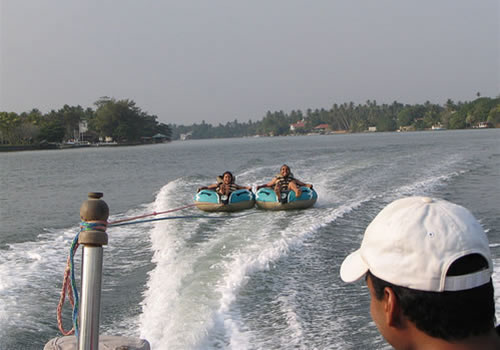
Best Beaches of the World: Bentota Bay Beach Resort, Sri LankaBeach, Lagoon, River, Swimming, Diving, Snorkelling trips, Waterskiing, Jetskiing, Tube-riding, Windsurfing, Deep sea fishing, Canoeing & River cruises
Bentota, Sri Lanka, 64 km down from Colombo, is the second tourist resort following Beruwala
Bay Beach, 55 km down from Colombo by the same highway, (so we passed it few minutes ago) is the gateway to 140 km (86mile) stretch of
tropical beaches from Beruwala in western coast to Tangalla Bay Beach in the southern
coast. The outstandingly beautiful stretch of road is one of the most scenic routes in the island.
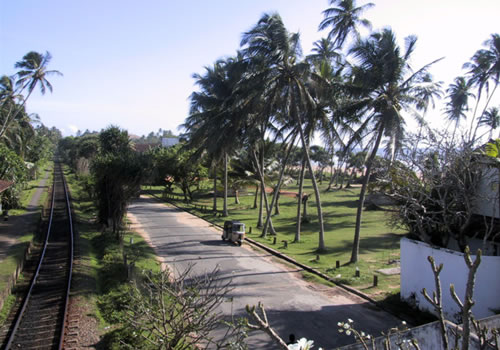
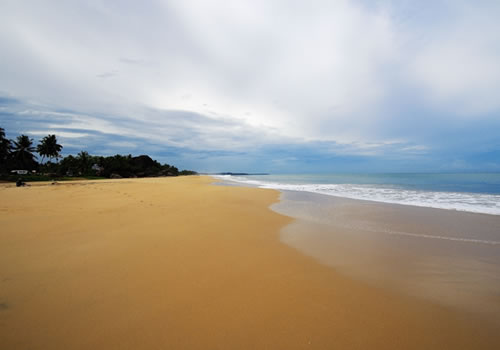
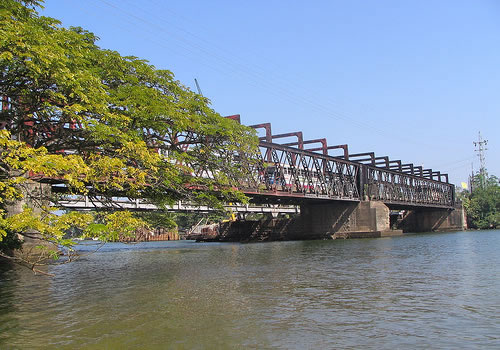
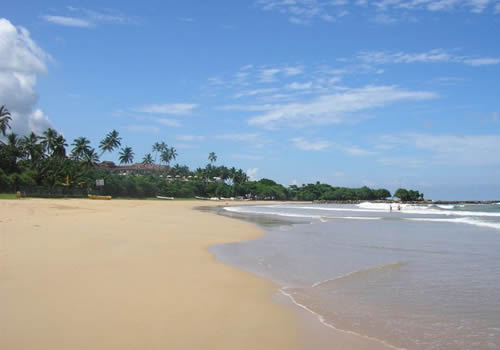
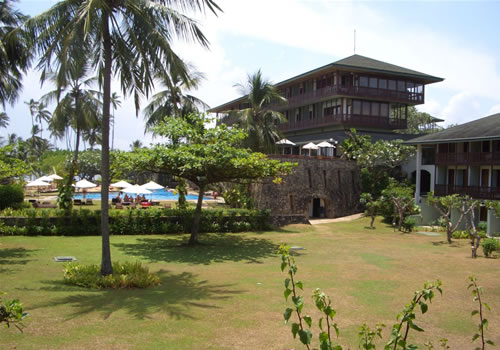
We just passed the raucous fish market of busy vendors with helpless crabs & lobsters, among a huge variety of fish at Aluthgama. We passed Toddy bars too. Toddy is a creamy white bubbling thick & smooth drink of liquor made of coconut sap (tapped from the frond of coconut) fermented in large clay pots-low percentage alcoholic beverage faintly reminiscent of cider. No hurry, we can have gallons of Toddy later today, at our leisure. Toddy galore in these towns. Cheap too. This is the border between the Western & Southern Provinces. Bridge over River BentotaWe cross the bridge over the River Bentota by car. The railway track of Diesel engine powered trains shares the same bridge. Over the bridge, over the waters of river Bentota, all of a sudden it is calm now. Did we miss something? We try to have a glance behind the car. We travelled from north to south over the bridge & now unlike us, the River Bentota that was running from east to west while we crossed the bridge suddenly changes its mind & takes a ninety degree turn. Now, the river flows north right from the very location of the bridge itself, parallel to the coast, for a few hundred meters, separated by the sea only by a narrow tongue of land. Sea from the west, sea from the north-the choppy breakers of the Indian Ocean, & calm waters of the river Bentota from East. The narrow spit of land is beautifully sandwiched & shaded with palm trees on both the seaward & river sides. It can be reached either from the beach or by boat across the river: the paradise island.The BeachSprawling under an endless canopy of palm trees, the beaches continue several kilometres south from Bentota. The attractive southern end of Bentota beach, i.e. south of the railway station, comprises a wide & tranquil swathe of sand that's home to one of the island's finest clusters of top-end luxury hotels, tastefully located & set at decent intervals from one another down the coast. Some of the hotels herein provide high quality Ayurvedic healing centres. Some of the most sumptuous places to stay in the entire island are located in these beaches from the resort Bentota to village Induruwa. Induruwa too has a small cluster of places to stay on a lovely, quiet length of beach.Bentota National Holiday Resort (NHR)Bentota National Holiday Resort spreading over an area of 100 acres is a strip of verdant land of greenery well shaded with groves of Coconut Palm tress, sandwiched between Bentota Beach and Galle – Colombo main road, which also sees railway line of Colombo – Matara running parallel to it. The Resort is a sustainable tourism project launched in 1969 and owned and managed by Sri Lanka Tourism Development Authority (SLTDA). While Lihiniya Hotel, Serendib Hotel, Cey Sands Hotel and Club Robinson Hotel too were established together with Bentota Beach Hotel in the initial stage of Bentota National Holiday Resort (NHR), Taj Exotica Hotel followed suit in time. NHR-Bentota offers a range of accommodation from 5 star of international standing to budget hotels. The Resort is home to restaurants, a shopping arcade, a bank, a post office, a Police post, a life saving unit, a unit of Red Cross, and a telecommunication center. The resort saw the establishment of its own central waste water and sewerage treatment plant in late 1990s. The success with aspects of sustainability of tourism at Bentota NHR has set a fine example on the concept of centrally planned tourist's resorts.During the colonial period of the British colonialists (1815-1948) in Sri Lanka, a rest house was built for the benefit of colonial civil servants and colonial entrepreneurs traveling between the seaport of Colombo to the sea-port of Galle, home to VOC Galle Dutch Fort. Today the 100 acres of tropical coastal strip of land provides the full gamut of water sports on the beach: wind surfing, water-skiing and diving. Facilities of Diving outfits & services are a regular feature of all the major hotels at Bentota. Then again deep-sea fishing too can be ventured into by the adventurous spirits. The River Bentota with its calm water affords the opportunities for still more water sports and boat trips upstream the River Bentota. National Resort Complex herein is built entirely for the foreign tourists. A gentle, leafy sprawl of hotels & guest houses along the coast provide a full range of water sports-wind surfing, water-skiing, deep sea fishing, diving. The beautiful calm waters of River Bentota too offers itself ready year round for your merry making in all sorts of water sports along with interesting boat trips up the river. All major hotels provide diving outfits & services. Water sports, PADI & CMAS courses
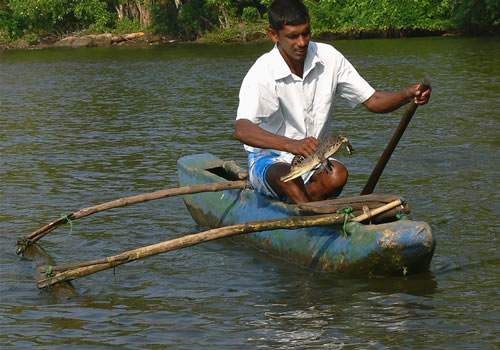
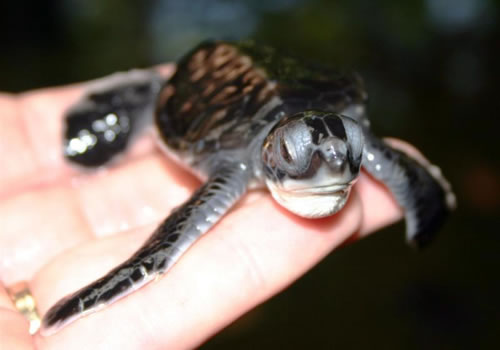
Boat safaris in River BentotaBoat trips along the River Bentota are quite popular. The Bentota lagoon is the last section of the broad River Bentota, a popular spot for boat safaris. Starting at the Bentota bridge & cruising inland, soon we will be in the lagoon dotted with tiny islands fringed with tangled mangrove swamps. Among aquatic birds-herons, cormorants & colourful kingfishers - as well as water monitors & crocodiles, the boatmen ferry (Who pay the ferryman? Allow me) us right in the thick of mangroves. The sight is mysterious & beautiful at once, as we cruise through shaded waters beneath huge roots. The longer the cruise, the further upriver we cruise, the more unspoilt the scenery becomes. Longer excursion includes side trip to coconut factories & handicraft shops. Most trips cruise for three hours while the Dinner Cruise last 5 hours. Grilled prawns with garlic butter, steaks, rice & curry & of course, The best dessert in the world, curd with Kitul palm honey.Turtle hatcheriesAt the north end of Induruwa is one of the turtle hatcheries set up to protect turtle eggs till they hatch. Turtle eggs, which would otherwise be eaten, are bought for a few rupees each from local fishermen & re-buried along the beach. Once hatched, the baby turtles are kept in holding tanks. Small tanks contain hundreds of one to three-day old turtles, as well as larger one, including an albino, kept for the collection. In the night, you can release a three-day-old turtle into the Indian Ocean to fend off itself. The beauty of the operation is the beaches are guaranteed the female baby turtles released herein will find their way back, sans GPS, in the depths of seven seas to their natal beach ten years later to lay their own eggs. The wonders & mysteries of our planet are endless. Let's protect it from the poachers, marauders & mass murderers. Five of the world's seven species of marine turtle visit Sri Lanka's beaches to nest, a rare ecological blessing. The government support for the conservation is a far cry from an ideal conservation project for an island that could easily be converted to the world's prime turtle-watching destination. In buying a baby turtle (from privately run turtle hatcheries) so that it could be released to the ocean, your wallet would loose a couple of dollars (let me put it this way: after all, keepers of the hatcheries too spent money buying the eggs from the fishermen, don't they?) to an eminently worthy cause. You would loose A Few Dollars More buying tortoise-shell ware (see, still we aren't saving all of the turtles, still not in the ideal situation), drums, masks & handmade lace. Lace of Portuguese origin, even 15th century Portuguese style ladies jackets made of white lace: Kabakorottu. That's what since15th century coastal belt generation to the generation as my grandmother's (all of them Sinhalese in our western & south-western coastal belt) wore in their times. My father, Baminahennadige Donald Benedict Peiris (8th April 1930 - 24th June 2005) of Lakshapatiya, Moratuwa too used to talk of traditions & costumes of the western coast.KosgodaIndependent turtle hatcheries run by villagers & Turtle conservation project (TCP) sponsored by UNDPTurtle Conservation Project. Bentota in Colonial History and Bentota Beach HotelSri Lanka’s first European invaders, the Portuguese (1505-1656) who dominated the maritime spice trade, built a fort on the bank of the Bentota river. No colonial fort would be complete without heavy artillery. So the Portuguese manned the fort with cannon. It was called Parangi Kotuwa in Sinhalese meaning the fort of the Portuguese. A century later the Dutch in Ceylon (1656-1796), who ousted the Portuguese let the fort fall into disrepair, bent much more on the trade, converted one of the large buildings within the fort into a colonial rest house for Dutch Officers en route from Galle, home to VOC Galle Dutch Fort and the seaport of Colombo.Following the Dutch, the British (1815-1948), who discovered the rest-house and found it a fine coastal sanitarium in which to spend beach holidays with friends and family. That was to give birth to colonial Bentota. The British were quite taken up with the definite quality of tranquility: with Bentota Rest House being its center of attraction, with beach, lagoon, river and wooded and sheltered terrain brought about a palliative ecology and air. Sir James Emerson Tennent (1804-1869), the colonial secretary of Ceylon (1845-1850) narrating in his book titled Ceylon, An Account of the Island (1859) says that the rest house at Bentota, situated within a little park, deeply shaded by lofty Tamarind trees on the point of the beach where the river forms its junction with the sea, is one of the coolest and most agreeable in Sri Lanka then called Ceylon. In his eyes the attractions at Bentota was enhanced (Oh! that’s an epicurean) by the lavish breakfast laid out by the civil officer, Mr. T. L. Gibson. The table was covered with all the luxuries at Bentota: fruits in great variety, curries, fish fresh from sea, and the delicacy for which the Bentota had earned a local renown, oysters detached off the rocks at the bottom of adjoining estuary with the mallets by the Sinhalese divers. When the river was at low tide, the oysters weren’t edible unless washed in salt water for at least two days. Hence the oysters were taken out at mid-tide. Bentota Beach Hotel built on the site of the Parangi Kotuwa Old Portuguese fort, was modeled after the Dutch star forts, having assimilated the traditional Sinhalese architecture of central open court yard making the hotel blend perfectly with the surroundings. Brief GardenTen kilometres north of Bentota is pretty Brief Garden. It used to be the home of landscape artist, sculptor & bon-vivant Bevis Bawa, older brother of illustrious Geoffrey Bawa, one of the twentieth century's foremost Asian architects whose work includes the new Parliament, Ruhunu University & renowned top-end eco-friendly hotels, Kandalama Hotel, Bentota Beach Hotel etc. of the island. In 1929 Major Bevis Bawa of British Army in Ceylon began landscaping the 5 acre garden his father had purchased following a successful legal brief. Having cleared the Rubber plantation, Bawa set to work creating a verdant romantic folly of inviting alcoves, nooks & bowers & garden sculpture. Bawa continued his masterpiece to his death in 1992. In the backdrop of undulating landscape of paddy fields & scattered villages on a hillside, Bawa designed a delightful series of cool shady terraces of wonderfully composed views, designed in various moods with references to European & Japanese style gardens, which tumble luxuriantly down the hillside below the house. And then there are wide lawns, ponds & a hilltop lookout too. The house itself wouldn't take a backseat to the garden. The artwork on display is eclectic, ranging form homoerotic sculpture to a wonderful mural of Sri Lankan life in the style of Marc Chagall. Some of the artwork was done by Bawa himself. The mural was created by the Australian artist Donald Friend, who hadn't intended to stay more than six days but ended up staying in Ceylon (then name of Sri Lanka) for six years. The fascinating collection of photographs includes a photograph of Bevis Bawa posing with house guests Vivien Leigh (Gone with the Wind) & Laurence Olivier (Oh! Ah!) during their filming of Robert Standish's famous novel "Elephant Walk" in 1953. And Emperor Edward the 8th to the boot.Robin Maugham at Brief GardenSpurred by his uncle William Somerset Maugham (1874-1965), Robin Maugham (1916 -1981) an investigative journalist, novelist, travel writer set off on what he would later describe as his Search for Nirvana. Nirvana being almost endless cycles of death and birth away and next to the supreme enlightenment, Robin Maugham, to his consolation, found Brief Garden at Bentota six miles away from the Bentota National Holiday Resort. He gushed: Brief Garden is a Paradise; it is a Shangri-la, a glimpse of Nirvana-call it what you will after you have been to see it. The harmony of the Brief Garden is unexpected because, as Bevis Bawa explains it, it consists of a collection of several small gardens-thought out by him in various moods and at various times during its growth over the last forty years. The result is a climax of loveliness, a proclamation that nature can triumph over the hideous inventions of mankind. In the leafy trees and shrubs the wild birds call and sing. Flowers glitter in the sunshine. Gracefully-shaped vistas reach out towards the horizon. Tranquility pervades the green terraces. Peace covers the house with a soft cloak. Peace falls over the lawns like a blessing. Peace is everywhere. For this place is a Paradise, made by the sensibility of one man, created by his patience and his love.Geoffrey Bawa himself appear in avatars: here in the form no other than God Bacchus himself, holding a birdbath shaped as a giant clam-shell, there in the shape of water-spouting gargoyle with wild hair & blue marble eyes. Bawa, himself was an imposing character, intellectually, socially as well as physically. He was 6 feet 7 inches tall. That is as tall as South African born former captain of England, fabulous Tony Greg, the most colourful commentator in Cricket today. And impartial too, as is the champion of champions, Illustrious Ravi Shastri of India. |
|
|
Copyright 2007-2012 - All Rights Reserved by Riolta Lanka Holidays (Pvt) Ltd. Web Site Design by Web Crafts (Pvt.) Ltd. |